Salesforce Data 360 Agentic Enterprise Reference Architecture
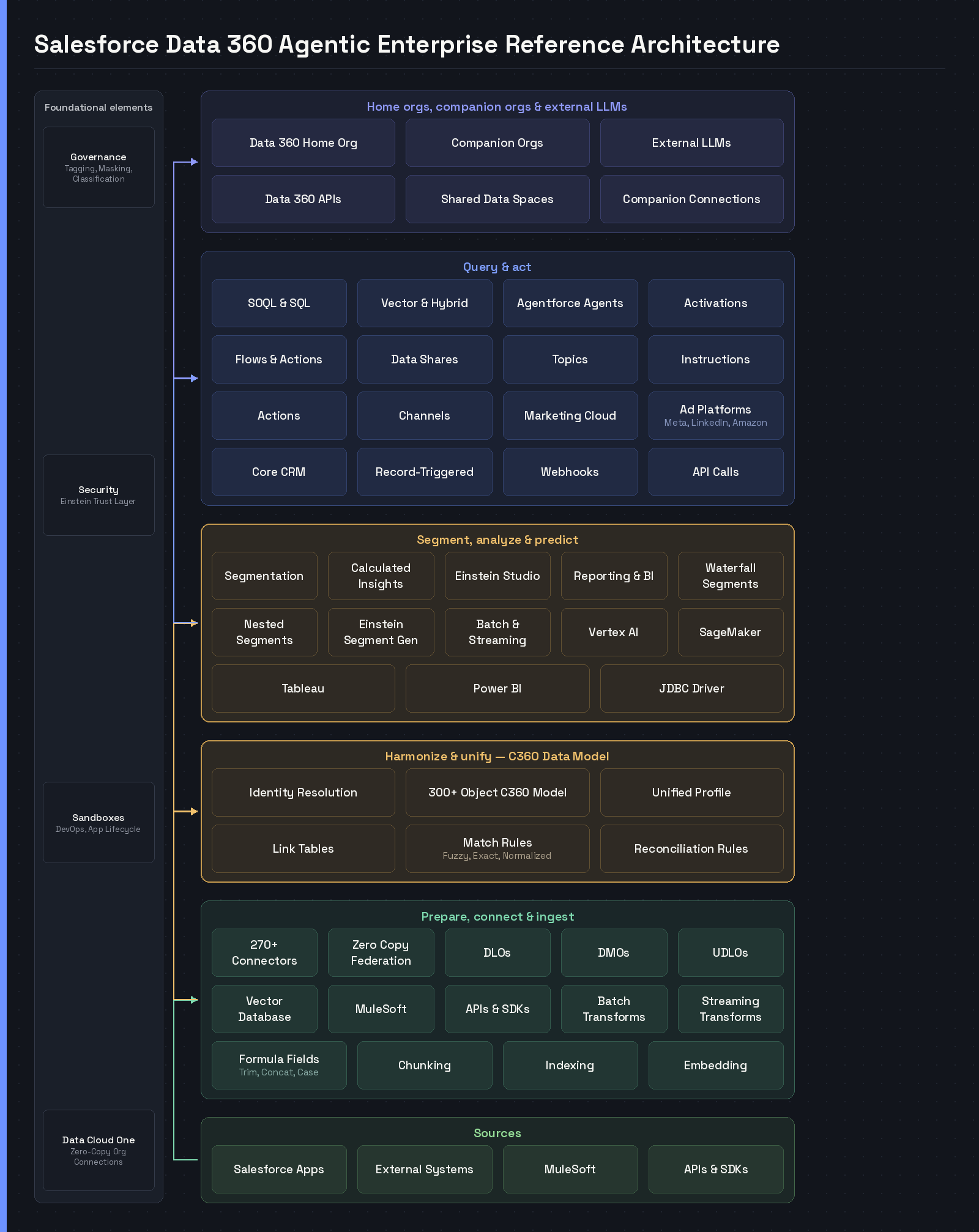
A reference architecture for Salesforce Data 360, from ingestion through the unified C360 profile to agents, activations and governance.
The challenge
Turning data scattered across Salesforce apps, external systems and unstructured content into one governed customer profile that agents, not just dashboards, can act on.
Most customer data platforms stop at the unified profile: harmonize the records, publish a segment, hand it to a campaign tool. Data 360 is built to go one step further — the same profile that powers a segment is also what an Agentforce agent queries mid-conversation, which is why identity resolution and governance sit underneath everything rather than beside it.
How it works
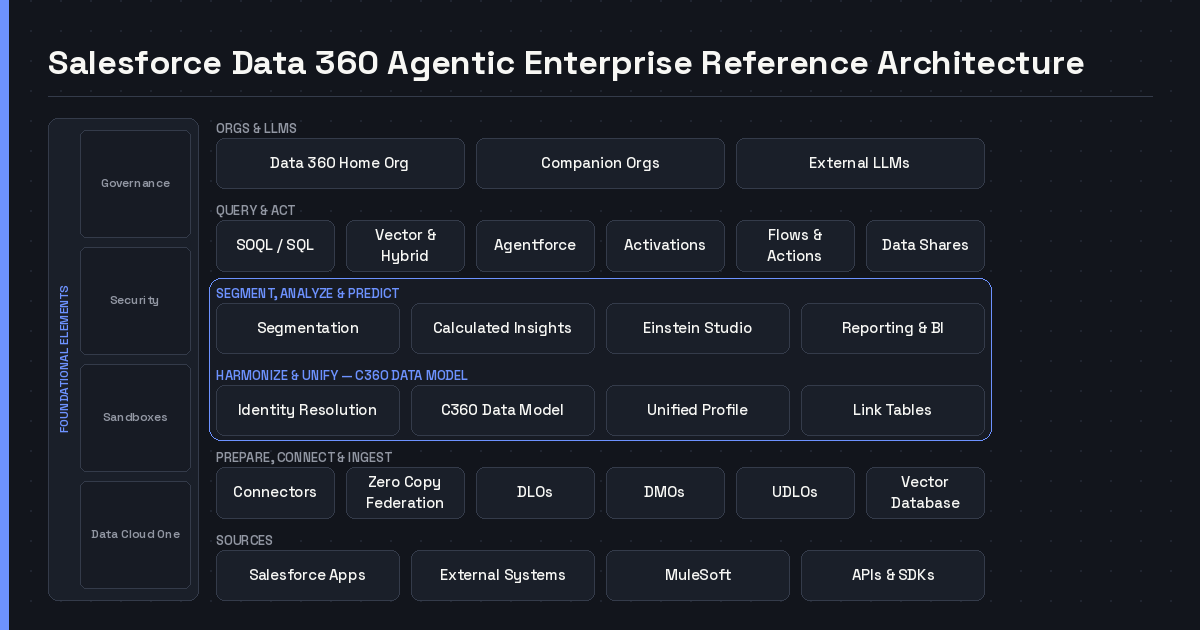
Data enters from Salesforce apps, external systems and MuleSoft, or through zero-copy connectors that read data in place rather than duplicating models and pipelines someone already built. Everything lands as Data Lake Objects in its native schema, then maps onto Data Model Objects on the C360 schema — over 300 industry-agnostic objects, extendable for a specific domain. Unstructured content takes a parallel path: chunking, indexing and embedding into UDLOs so it’s searchable alongside structured records.
Harmonization is where the platform earns the name. Match rules group records that likely belong to the same person — fuzzy, exact or normalized, weighted by recency or source trust — and reconciliation rules pick the best value from each group. The result is a gold-standard unified profile, with link tables preserving the trail back to every source record rather than collapsing them.
Everything above the unified profile reads from it: waterfall and nested segments, calculated insights, Einstein Studio predictions and bring-your-own models, and queries over SOQL, SQL or vector search. Query and Act is the layer that turns a unified record into a decision — an Agentforce topic, an activation to an ad platform or Marketing Cloud, a triggered flow, or a zero-copy data share back to a partner system.
The top layer is what makes this an enterprise architecture rather than a single-org one: a Data 360 Home Org shares data spaces with Companion Orgs and exchanges metadata with other Home Orgs and external LLMs, so the unified profile isn’t trapped in the org that first ingested it. Running the full height beside all of it, the foundational rail — governance, the Einstein Trust Layer, sandboxes, Data Cloud One — is what keeps a fast-moving agent from also being an ungoverned one.
The original design
The diagrams above are built from the Data 360 architecture concept below, designed by Jordan Seeley at Salesforce.
Salesforce Data 360 Agentic Enterprise Reference Architecture, July 2026 — design credit: Jordan Seeley, Salesforce. View in Figma.
What to get right
- Reconciliation rules decide what “true” means. Two source systems that disagree on a customer’s email or phone number resolve however the reconciliation rule says to — get the trust ranking wrong and every layer above inherits a wrong answer with high confidence.
- Don’t copy what zero-copy can federate. The 270+ connectors exist so data already modeled in a partner platform doesn’t need a second pipeline and a second place to go stale.
- Unstructured data needs the same rigor as structured. Chunking and embedding choices for UDLOs are a modeling decision, not a default to accept — they determine what vector search can actually retrieve.
- Design the companion-org boundary before you need it. Shared data spaces and companion connections are how a Home Org scales past one org; bolting that on after launch means re-litigating access to data already in production.
- Governance is not a layer you visit later. Tagging, masking and classification set at ingestion are what make every downstream segment, agent and data share provably compliant instead of merely convenient.
How it fits together
Sources
Salesforce apps, external systems, MuleSoft integrations, and APIs and SDKs. Over 270 connectors plus zero-copy federation mean data already modeled elsewhere doesn't have to be copied to be used.
Prepare, connect and ingest
Data lands in Data Lake Objects (DLOs) in its original schema, then maps to Data Model Objects (DMOs) on the C360 schema. Unstructured content goes through Unstructured Data Lake Objects (UDLOs), chunking, indexing and embedding for vector and hybrid search.
Harmonize and unify — C360 Data Model
Identity resolution applies match rules — fuzzy, exact, normalized — to group individuals, then reconciliation rules pick the best-quality data to build a gold-standard unified profile. Link tables tie related records to the unified individual without altering the originals.
Segment, analyze and predict
Waterfall and nested segments, calculated insights computed in batch or streaming, Einstein Studio for predictions and bring-your-own-model, and reporting through native dashboards, Tableau, Power BI or the Data 360 JDBC driver.
Query and act
SOQL, SQL and vector/hybrid search over the unified data, surfaced to Agentforce agents, activations to downstream platforms, record-triggered flows and actions, and zero-copy data shares back out to external systems.
Home orgs, companion orgs and external LLMs
A Data 360 Home Org shares data spaces and companion connections with Companion Orgs, and exchanges data with other Home Orgs via the Data 360 APIs, enrichments and record-triggered flows — the multi-org layer the rest of the stack runs inside.
Foundational elements rail
Governance (tagging, masking, classification, the digital wallet), security built on the Einstein Trust Layer, sandboxes for DevOps and application lifecycle management, and Data Cloud One for zero-copy connections between CRM orgs — running the full height of the stack.
Typically built with
- Data Cloud (Data 360)
- Agentforce
- MuleSoft
- Zero Copy / BYOL connectors
- Einstein Studio
- Einstein Trust Layer