Real-Time Agentic AI Reference Architecture using an Event Mesh
A reference architecture for real-time agentic AI, where gateways, an event mesh, an orchestrator and specialist agents stay loosely coupled.
The challenge
Letting autonomous agents react to enterprise events in real time — across clouds, frameworks and protocols — without wiring every agent directly to every system it needs.
An Agentic AI system is a collaborative group of autonomous agents that reason, plan, and act on their own as per the context. Building mission-critical production systems requires real-time distributed data, decentralized and loosely-coupled system integration, production-grade scalability and performance, and fault tolerance and reliability. An event-driven architecture (EDA) has been a key enabler for building such complex enterprise-grade distributed systems and offers the following advantages in terms of building Agentic AI applications, extending its core architectural benefits:
- Improved scalability, reliability and usefulness of legacy applications by enabling them for real-time information exchange
- Accelerated innovation for applications and services with simplified integration into existing business processes
- Flexible asynchronous communication backbone and decoupled one-to-many integrations
How it works
sequenceDiagram
    autonumber

    actor Gateway as Gateways (Slack, REST, Sensors)
    participant Mesh as Event Mesh (Message Broker)
    participant Orchestrator
    participant Registry as Agent Registry
    participant HumanQ as Human Decision Queue
    participant Agent as Agent (Microservice)
    participant MCP as MCP Server
    participant API as Enterprise APIs
    participant Subs as Subscribers (Maintenance, Comms)

    Gateway->>Mesh: Ingest request & publish Event
    Mesh->>Orchestrator: Deliver Event (Subscriber)

    activate Orchestrator
    Note over Orchestrator: Decomposes event into tasks
    Orchestrator->>Registry: Check authorization scope
    Registry-->>Orchestrator: Auth confirmed

    alt Requires Human Action
        Orchestrator->>HumanQ: Publish to Human Decision Queue
        Note over HumanQ: Human approves/confirms
        HumanQ-->>Mesh: Publish decision back to mesh
    else Automated Task
        Orchestrator->>Mesh: Dispatch task to specific Agent Queue
    end
    deactivate Orchestrator

    Mesh->>Agent: Agent consumes from its own queue
    activate Agent

    opt Tool & Data Access
        Agent->>MCP: Request data/action
        MCP->>API: Execute OpenAPI-defined call
        API-->>MCP: API Response
        MCP-->>Agent: Formatted tools/data
    end

    opt A2A Delegation
        Agent->>Mesh: Delegate to another Agent (CrewAI/LangGraph)
        Mesh-->>Agent: Return delegated results
    end

    Agent->>Mesh: Publish final generative results
    deactivate Agent

    par Global Broadcast
        Mesh->>Subs: Deliver to Maintenance
        Mesh->>Subs: Deliver to Staffing
        Mesh->>Subs: Deliver to Public Comms
    end
Why event-driven architecture (EDA) for Agentic AI
| Concern | Traditional Approach | Event Mesh |
|---|---|---|
| Adding an agent | Change the caller of every flow it joins | Subscribe to a topic; no producer changes |
| Load spikes | Caller blocks or times out | Broker buffers; agents drain the queue |
| Agent failure | Caller fails with it | Events queue or reroute; backlog processed on recovery |
| Fan-out | Caller loops over recipients | One publish, many subscribers |
| Framework mix | Callers couple to each agent’s API | Agents share an event contract, not a runtime |
| Placement | Network topology leaks into agent code | Mesh links span cloud, on-prem and edge |
Key Questions
Q1) What is the role of Event Mesh in an Agentic AI architecture?
An event mesh is a network of interconnected event brokers that routes, filters and persists events across cloud, on-premises, and edge environments. In an Agentic AI architecture, it elevates the communication layer agents publish and subscribe to, replacing direct agent-to-agent calls with asynchronous, location-agnostic messaging.
Q2) How is this different from an orchestrator-only agent framework?
A framework like LangGraph or CrewAI coordinates agents inside a platform-specific runtime. The event mesh coordinates across runtimes, teams and deployment environments, so agents written in different frameworks and owned by different teams interoperate without sharing a process, a language or a release schedule.
Q3) Where do MCP and A2A fit?
They solve different problems. Model Context Protocol gives an agent a standardized way to use tools and reach APIs, often bridging to OpenAPI-defined enterprise services. Agent2Agent gives agents a standardized way to discover and delegate to each other. The mesh carries both patterns; neither replaces it.
Q4) What are example use-cases where Agentic AI systems and EDA can be leveraged?
- Customer service application where intelligent agents are proactively resolving queries and learning from each interaction.
- Real-Time Operational Intelligence & Analytics where existing operating systems like order or inventory management systems can offer an AI-enabled conversational interface without major refactoring
- Knowledge Management & onboarding where building enterprise-specific knowledge needs continuous learning and adaptation from real-time data
Reference
This architecture follows the reference model in The Architect’s Guide to Real-Time Agentic AI by Solace.
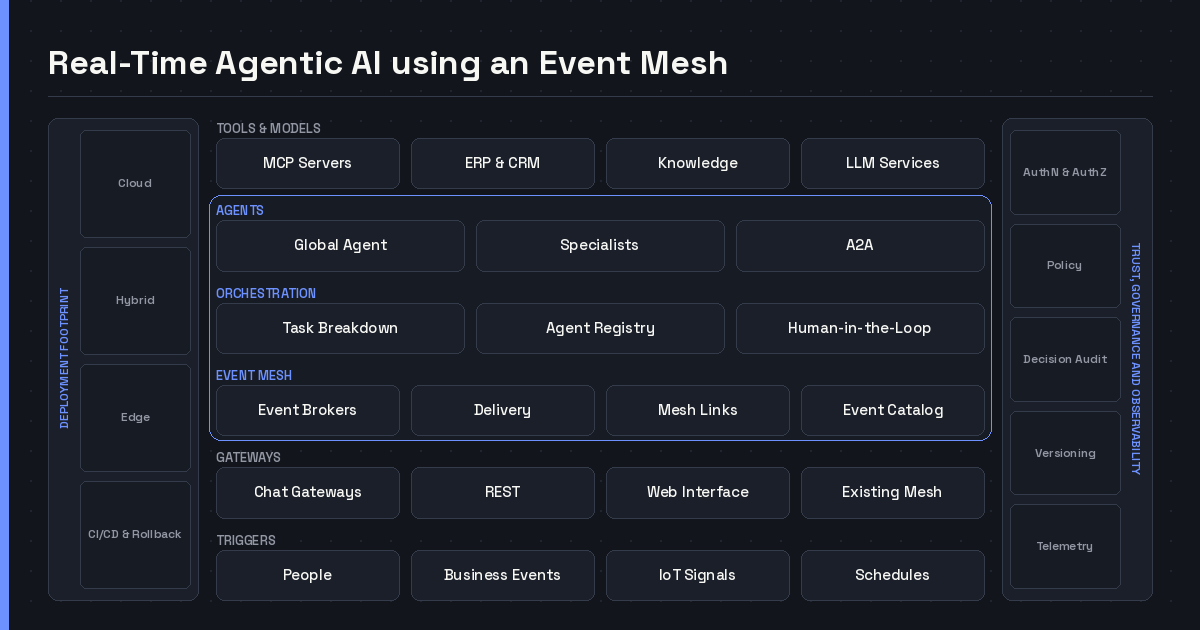
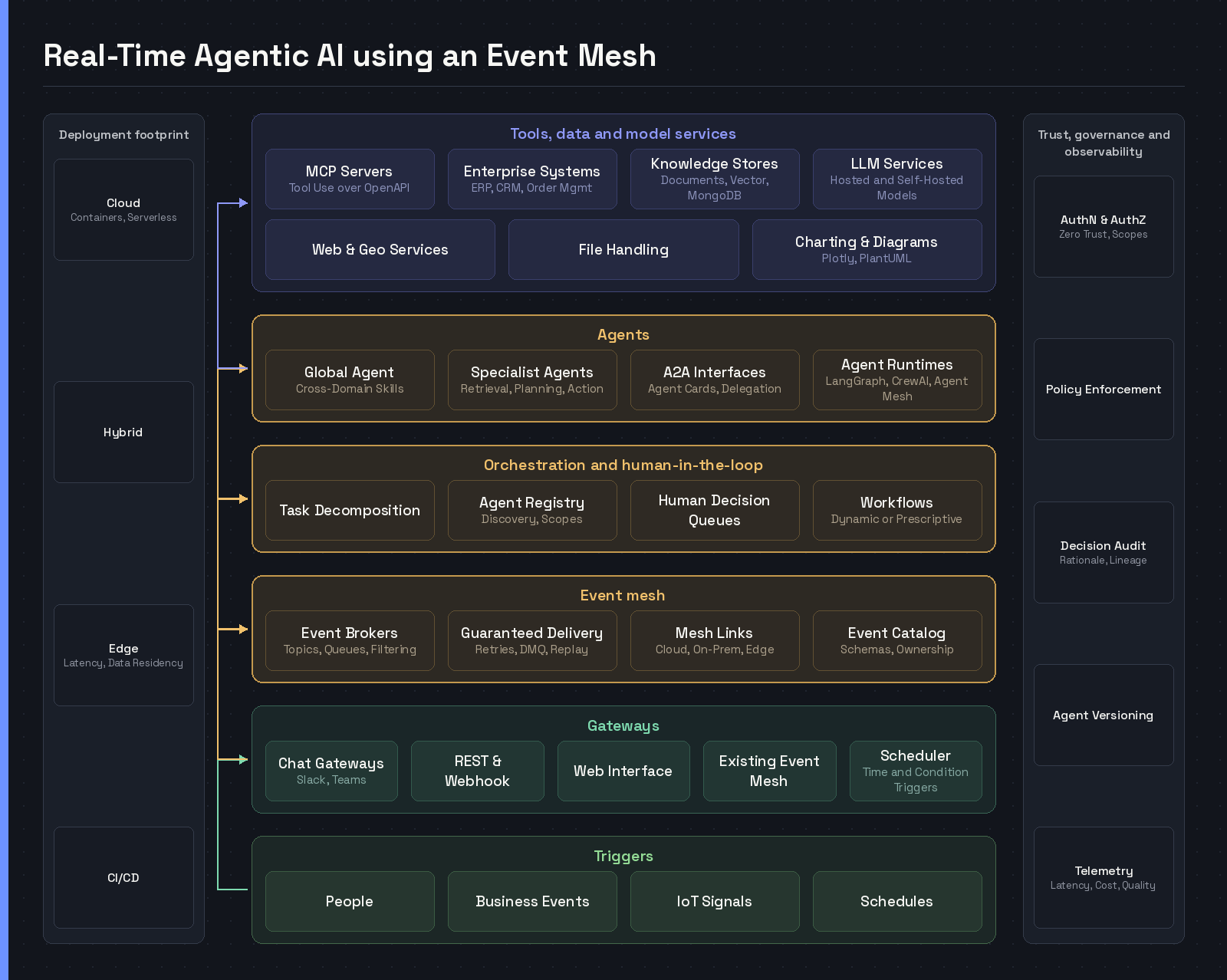
How it fits together
Triggers
Agents are started by more than a chat box: a person asking a question, a CRM record changing, an ERP posting, an IoT sensor spiking, or a time-based or conditional schedule. Multi-channel initiation is what puts agents in the business fabric rather than beside it.
Gateways
Each channel — Slack or Teams, REST and webhooks, a web interface, an existing event mesh, a scheduler — terminates at a gateway that authenticates the caller and turns the request into an event. Adding a channel is a new gateway, not a change to any agent.
Event mesh
The real-time backbone. Brokers route, filter and persist events across cloud, on-premises and edge; guaranteed delivery, retries, dead-message queues and replay absorb speed mismatches and failures; the event catalog keeps schemas and ownership discoverable.
Orchestration and human-in-the-loop
Breaks a request into tasks and dispatches them to the right agents in real time, using dynamic or prescriptive workflows and an agent registry that enforces authorization scopes. Manual decision queues route validation, confirmation and escalation to people, so edge cases stay accountable instead of getting automated past.
Agents
A global agent with cross-domain skills plus specialists for retrieval, planning and action, each independently deployed, scaled and versioned. A2A interfaces let agents built on different frameworks — LangGraph, CrewAI, Agent Mesh — delegate to one another.
Tools, data and model services
MCP servers front tools and OpenAPI-defined APIs; ERP, CRM and order management supply operational state; document, vector and record stores supply context; hosted and self-hosted LLMs supply reasoning. Charting, file handling and web or geographic lookups round out the toolbox.
Deployment footprint
Consistent deployment across cloud, hybrid and edge using containers, serverless runtimes or VMs — so an agent can sit next to its data for latency or residency reasons without becoming a special case. CI/CD carries rollout and rollback.
Trust, governance and observability
Authentication, authorization and policy enforcement at every level, plus decision-chain auditing, data lineage, agent versioning and telemetry on latency, cost and decision quality — the record of who acted, why, and on what data. Aligns with TOGAF principles so the pipeline reads as enterprise architecture, not a bolt-on dashboard.
C4 View
System Context
C4Context
  title System Context — Real-Time Agentic AI Event Mesh
  Person(user, "Business User", "Asks a question or triggers a workflow via chat, form, or API")
  System_Ext(source, "Enterprise Systems", "CRM, ERP, IoT sensors, schedulers — publish the events agents react to")
  System(mesh, "Agentic AI Event Mesh", "Routes events to autonomous agents and orchestrates their responses in real time")
  System_Ext(tools, "Tools & Data", "MCP-fronted APIs, document/vector stores, LLM providers")
  System_Ext(human, "Human Reviewers", "Approve, confirm, or escalate decisions the mesh routes to them")

  Rel(user, mesh, "Sends request / receives result")
  Rel(source, mesh, "Publishes business events")
  Rel(mesh, tools, "Calls for data, action, and reasoning")
  Rel(mesh, human, "Routes decisions needing approval")
Container
C4Container
  title Containers — Real-Time Agentic AI Event Mesh
  Person(user, "Business User")
  System_Boundary(mesh, "Agentic AI Event Mesh") {
    Container(gateway, "Gateways", "Slack, REST, Webhooks, Schedulers", "Authenticates callers and turns requests into events")
    Container(broker, "Event Mesh", "Kafka / Solace PubSub+", "Routes, persists, retries, and replays events")
    Container(orchestrator, "Orchestrator", "LangGraph / CrewAI", "Decomposes requests into tasks and enforces authorization scopes")
    Container(registry, "Agent Registry", "Service catalog", "Tracks agents and their authorization scopes")
    Container(humanq, "Human Decision Queue", "Managed queue", "Routes validation, confirmation and escalation to people")
    Container(agent, "Agents", "Microservices (A2A)", "Specialist and global agents that plan and act")
    Container(mcp, "MCP Server", "Model Context Protocol", "Fronts tools and OpenAPI-defined services")
  }
  System_Ext(api, "Enterprise APIs", "ERP, CRM, order management")
  System_Ext(llm, "LLM Services", "Hosted and self-hosted models")

  Rel(user, gateway, "Sends request")
  Rel(gateway, broker, "Publishes event")
  Rel(broker, orchestrator, "Delivers event")
  Rel(orchestrator, registry, "Checks scope")
  Rel(orchestrator, humanq, "Routes for human action")
  Rel(orchestrator, broker, "Dispatches task")
  Rel(broker, agent, "Delivers task")
  Rel(agent, mcp, "Requests data/action")
  Rel(mcp, api, "Calls")
  Rel(agent, llm, "Requests reasoning")
Typically built with
- Solace Agent Mesh / PubSub+
- Apache Kafka
- LangGraph
- CrewAI
- Model Context Protocol (MCP)
- Agent2Agent (A2A)
- AsyncAPI