Agentic AI Assistant for Wealth Advisors
A reference architecture for a multi-agent wealth advisor assistant on Google ADK and Vertex AI, with an orchestrator, specialists and compliance gates.
The challenge
A wealth advisor answers one client question by searching a CRM, a portfolio system, a research platform and a folder of PDFs by hand — slowly, and with no record of what was checked.
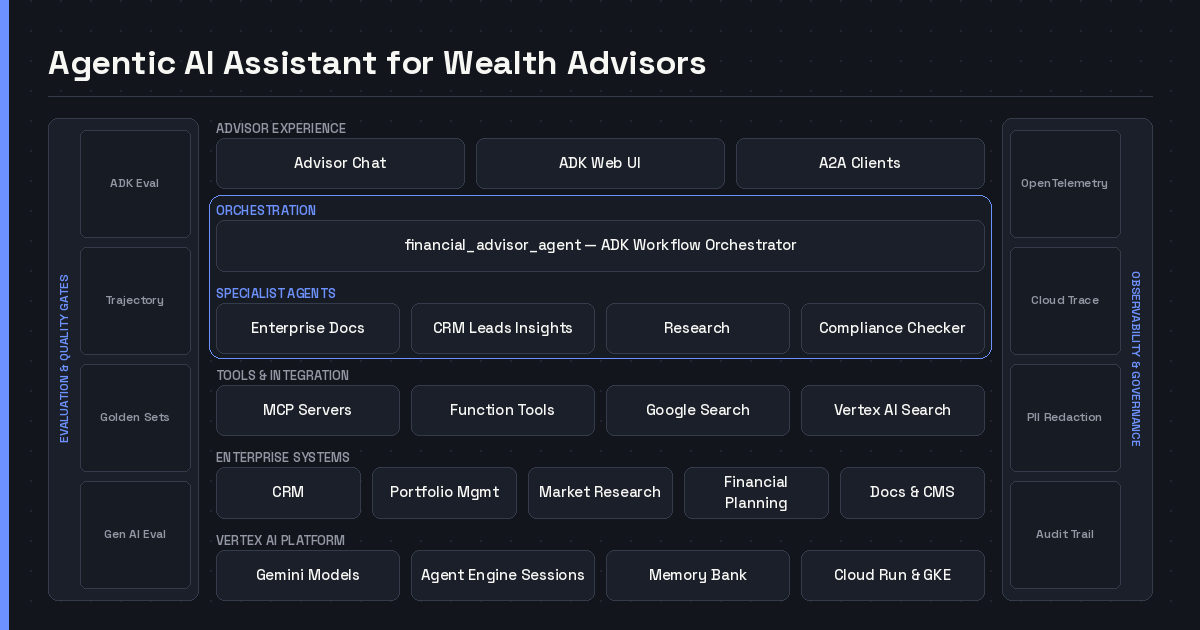
A wealth advisor’s knowledge is spread across systems that were never designed to be read together: a CRM for relationships, a portfolio system for holdings, a research platform for market views, a planning tool for goals, and a folder of PDFs for everything the enterprise says about its own products. Answering one client question means visiting several of them, correlating by hand, and remembering which answer came from where.
That is a retrieval problem on the surface and a synthesis problem underneath. A search box across all five systems still leaves the advisor to reconcile the results. The agentic version reasons over what came back, asks a follow-up when the request is ambiguous, and hands over an answer that has already been checked for compliance.
How it works
The orchestrator is an ADK LlmAgent whose tools are other agents. Routing is
therefore a model decision at runtime rather than a fixed graph, which is what
lets one advisor question fan out to the CRM and the document index while the
next needs neither:
def create_financial_advisor_agent() -> Agent:
    """Knowledge orchestrator: sub-agents exposed to the model as tools."""
    return LlmAgent(
        name="financial_advisor_agent",
        model=Gemini(model=settings.vertex_ai_model, retry_options=retry_config),
        description=(
            "guide advisors through a structured process to their financial "
            "queries by orchestrating a series of expert subagents"
        ),
        tools=[
            AgentTool(agent=financial_enterprise_docs_agent),
            AgentTool(agent=google_research_agent),
            AgentTool(agent=crm_leads_insights_agent),
            AgentTool(agent=compliance_checker_agent),
        ],
        instruction=FINANCIAL_ADVISOR_PROMPT,
        output_key="financial_advisor_output",
    )
Each specialist owns its own tools and — importantly — its own model choice. The compliance check does not need the same model as open-ended research, and splitting them is what makes the cost and latency of each hop tunable:
compliance_checker_agent = LlmAgent(
    name="compliance_checker_agent",
    model=Gemini(model=settings.vertex_ai_compliance_model, retry_options=retry_config),
    description="ensures responses are complete, accurate and compliant, including AI disclosure",
    instruction=COMPLIANCE_CHECKER_AGENT_PROMPT,
    tools=compliance_tools,
)

crm_leads_insights_agent = LlmAgent(
    name="crm_leads_insights_agent",
    model=Gemini(model=settings.vertex_ai_model, retry_options=retry_config),
    description="Insights agent for CRM leads and prospects",
    instruction=CRM_LEADS_INSIGHTS_AGENT_PROMPT,
    tools=[FunctionTool(func=crm_dataframe_tool.query_dataframe)],
)
Adding a system means adding an agent and its tools, not rewriting the orchestrator. Portfolio management (Envestnet, Yodlee), research (Morningstar, Yahoo Finance) and financial planning (eMoney, RightCapital, MoneyGuidePro) all extend the same shape.
What to get right
- Make compliance a hop, not a prompt instruction. A separate agent with its own model and tools produces an artifact you can log and audit. A paragraph in the orchestrator’s system prompt produces nothing you can show a regulator.
- Keep public research in its own agent. Search results are untrusted content. Merging them into the same context as client data, with no boundary, is how prompt injection reaches a CRM tool.
- Persist sessions outside the process. Advisor conversations span a working day and survive deploys. Agent Engine Sessions and Memory Bank make that the platform’s problem rather than a sticky-session workaround.
- Trajectory beats output-only evaluation. ADK eval scores which tools were called in what order, which catches the failure that matters here: a plausible answer assembled from the wrong system.
- Budget the fan-out. Every AgentTool call is another model round trip. Cap steps, tokens and wall-clock time per request, or one ambiguous question becomes an unbounded bill.
The reference implementation is on GitHub and continues to be extended; the design rationale is written up in more depth in this article on Medium.
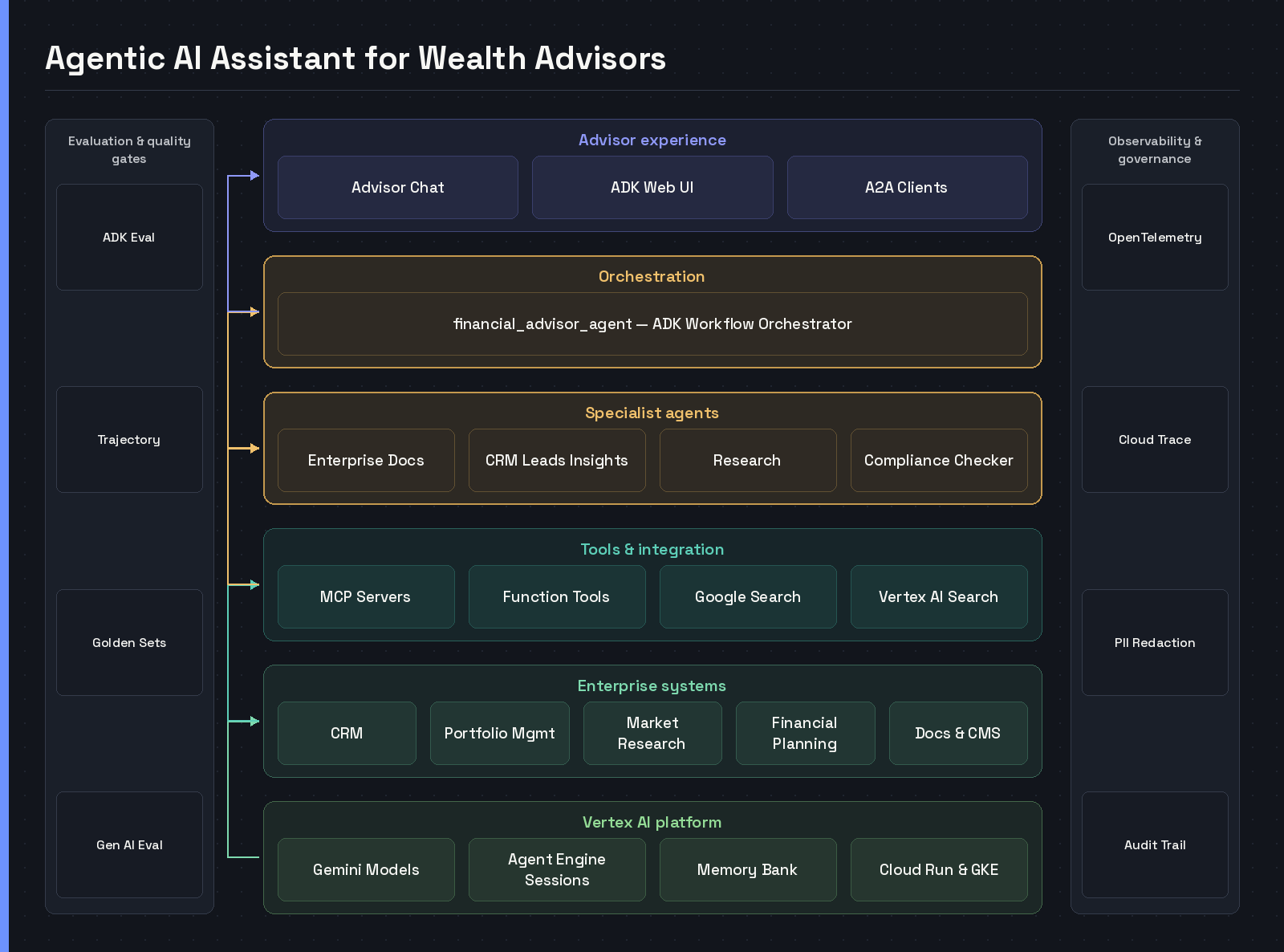
How it fits together
Advisor experience
The advisor's chat surface in production, the ADK Web UI for development and eval runs, and A2A endpoints so other agents can call this one as a service rather than through the UI.
Orchestrator — financial_advisor_agent
Interprets advisor intent and decides which specialists to call, in what order, and when it has enough to answer. Sub-agents are wrapped as AgentTool, so routing is a model decision inside one agent rather than a hand-written state machine.
financial_enterprise_docs_agent
Retrieves from proprietary unstructured content — product PDFs, policy documents, CMS knowledge hubs — grounded against a managed index so answers cite the enterprise's own material.
crm_leads_insights_agent
Turns CRM leads and pipeline data (Salesforce, Zoho, Redtail, HubSpot) into structured answers about relationships and prospects, queried through a tool rather than pasted into the prompt.
google_research_agent
Public market and company research via Google Search grounding, kept as a separate agent so external content never enters the same context as client data unlabelled.
compliance_checker_agent
The last hop before the advisor sees anything: checks completeness and accuracy against regulatory standards, enforces AI-disclosure requirements, and redacts personal or sensitive data.
Tools and MCP integration
Each specialist carries its own toolset — FunctionTool for in-process calls, MCP servers for standardised access to external systems. New systems arrive as tools, not as new orchestration code.
Sessions and long-term memory
Vertex AI Agent Engine Sessions persist conversation state across restarts and failovers; Memory Bank consolidates what matters across sessions so the assistant carries context between advisor conversations.
Evaluation and quality gates
ADK eval runs tool-trajectory and response-quality checks as regression tests in CI, extended by the Vertex AI Gen AI evaluation service. A prompt or model change ships only if the scores hold.
Observability and deployment
OpenTelemetry traces every agent hop, tool call and token spend into Cloud Trace and Vertex AI monitoring. The same agent deploys to Agent Engine, Cloud Run or GKE without code changes.
Typically built with
- Google ADK
- Vertex AI Agent Engine
- Gemini
- Model Context Protocol
- Cloud Run
- OpenTelemetry