What Skills Do You Need for an FDE Role? A T-shaped Career Guide
A Forward Deployed Engineer (FDE) sits at the intersection of full-stack software engineering, solution architecture, and client management and is the key enabler for successful Agentic AI deployments. FDEs are embedded directly within a client’s environment to understand the enterprise context, including their platform & data engineering, internal systems & applications, and organization-specific build & release process, architecture review and approval guidelines, and many more. FDEs are not shipping a generic product, but wiring core product & platform infrastructure based upon the enterprise architecture, architecture decisions (ADRs), and best practices & guidelines within the boundaries and Enterprise SLAs. Palantir made the title & concept famous in the industry, but the core idea of an SME (Subject Matter Expert) driving platform implementation in an organization has always been a key success factor.
What actually decides whether an FDE succeeds
I think the most important part of a forward-deployed engineer role is understanding the business problem you’re trying to solve, and then applying real knowledge of the product or platform you’re implementing. Same as in the past, it was never a tool or a technology — it’s a combination of people, process and technology mindset that made it possible. Being on the customer’s location, understanding the domain knowledge, and applying the solution to solve the business problem, justifying the ROI: that’s the success criteria for an FDE. The challenging part is acquiring the emerging skill set — agentic design patterns, best practices for production-grade apps, the productionisation techniques for this new set of AI engineering methods — and that isn’t easy, because the AI engineering landscape keeps changing - Ankur Kumar
Read that against the two boxes this guide keeps circling back to. Technical Discovery is where you find out whether you actually understand the domain, not just the requirements document. The Product Feedback Loop is where product knowledge gets tested against a real client requirements instead of a demo script. Get those two right and a thinner depth bar still ships something the client needed. Get them wrong, and the deepest LangGraph expertise in the world builds an excellent answer to the wrong question. The success factor is in finding the right balance.
And the “isn’t easy” part deserves to be taken literally rather than as a caveat. An architect who went deep on Java in 2015 is still deep on Java. An FDE who went deep on agentic design patterns eighteen months ago is already behind — the patterns, the evaluation practice, and what “production-grade” even means for an agent have all moved since, and will move again before this stack is retired. Depth here is not a credential you build once, as it is a continuous process that you evolve as the solution progresses in the enterprise environment.
The T-Shape: eight boxes wide, one agentic stack deep
A T-Shaped skill set has a horizontal bar — the breadth you can reason across — and a vertical bar — the depth you actually own. For an architect, the vertical bar is usually a language or a domain. For an FDE, it is narrower and sharper: one agentic AI stack, learned deep enough to build and implement as a production-grade application.
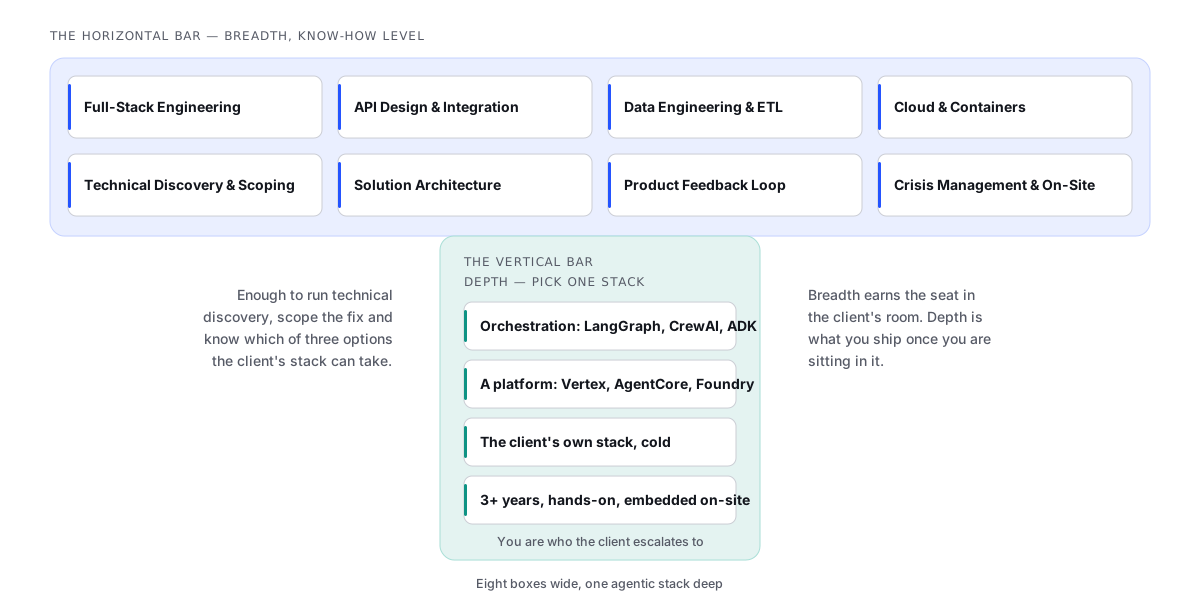
The breadth bar exists so you can walk into an enterprise discussion and ask the right question (the foundation of system design and in-depth knowledge of design patterns like [Gang of Four][https://en.wikipedia.org/wiki/Design_Patterns) remains relevant. The depth bar exists so that when the answer requires code or implementation, you have the skill set to do it using an AI coding agent or yourself.
I have observed the same AI coding agent (Claude Code, Copilot, or Codex) being used effectively or inefficiently, producing a lower-quality solution or high-grade production-ready app. The knowledge of the FDE driving the agent with Prompt Engineering, Context Engineering Practices, Plugins and SKILLs Configured, Applying Proven Practices like YAGNI, and more still matters the most - Ankur Kumar
The Horizontal Bar: Core Technical Stack
Eight areas, split across two concerns that a generalist architect role does not carry: shipping production code yourself, and doing it in a client’s building under a clock.
Full-stack Software Engineering & System Design Knowledge
Fluency in a modern programming language — Python, Java, Go, Rust or others — and API design applying practices such as REST, OpenAPI, GraphQL and gRPC. This is the part that separates an FDE from a solutions consultant: you write the custom integration, you do not spec it for someone else to build. If this bar is thin, top microservices frameworks in Go and top microservices frameworks in Java are a reasonable place to firm it up.
Data Engineering & ETL
Large-scale pipelines, SQL optimisation, and distributed systems — Kafka, Spark, Snowflake — to ingest a client’s data without becoming the reason their nightly batch job breaks. Client data rarely arrives clean, documented, or in the shape the demo assumed; this is the skill that gets it into the agent’s context at all.
Cloud & Infrastructure
Hands-on containerization with Docker and Kubernetes, and comfort in at least two of the three major clouds, because the client picks the cloud, not you. You are deploying inside their infrastructure, which means their IAM, their network policy, and their change-control process — not a sandbox account you control end to end.
GPU Infrastructure
Understand the basics of how GPUs work even if you are not a hardware expert, including basics of GPU Architecture. Read about NVIDIA GPU Architecture Evolution covering Blackwell, Hopper, Ada Lovelace Architecture, Ampere, Volta, and previous architectures.
Technical Discovery & Scoping
Translating a client’s messy, half-contradictory requirements into a precise technical spec and an architecture diagram they can sign off on. This is a listening skill before it is a drawing skill — the C4 model is a fast way to make the output legible to both engineers and the business sponsor in the same meeting. It is also where product knowledge earns its keep: a spec written by someone who understands what your product can and can’t do converges in one workshop; a spec written by someone who only understands the client’s ask goes through four rounds of “that’s not actually possible” before it converges.
Solution Architecture
Technology selection, integration design, and enough of the discipline in Developer to Architect: a T-shaped learning path to defend a build-vs-buy call under questioning. An FDE’s architecture decisions ship to one client, not a platform roadmap — which makes them faster to make and harder to walk back.
Product feedback loop
Channelling edge cases, bugs, and one-off feature requests from the field back into the core product roadmap. The best FDEs are a sensor network for product management: the client asked for a workaround this week because the platform is missing something that the next twenty clients will also ask for.
Client-facing communication
Discovery workshops, architecture reviews, and status updates to people who do not read your commit history. The skill is translation, not simplification — a stakeholder who understands the real trade-off makes a better decision than one who was handed a comfortable half-truth.
Crisis management
On-site troubleshooting and debugging complex deployment environments under enterprise SLAs, often with the client’s engineers watching the terminal over your shoulder. This is the box most engineering paths never train for directly, and it is the one that gets an FDE remembered — for better or worse.
The vertical bar: pick one agentic AI stack and go deep
This is where the FDE role has changed fastest. Five years ago the vertical bar was a language. Today, for any FDE working AI deployments, it is an agentic AI stack — one platform, learned to the point of being able to build, debug and extend it live in a client environment.
Seven platforms are worth recognising by name; go deep in whichever one your next client already runs on.
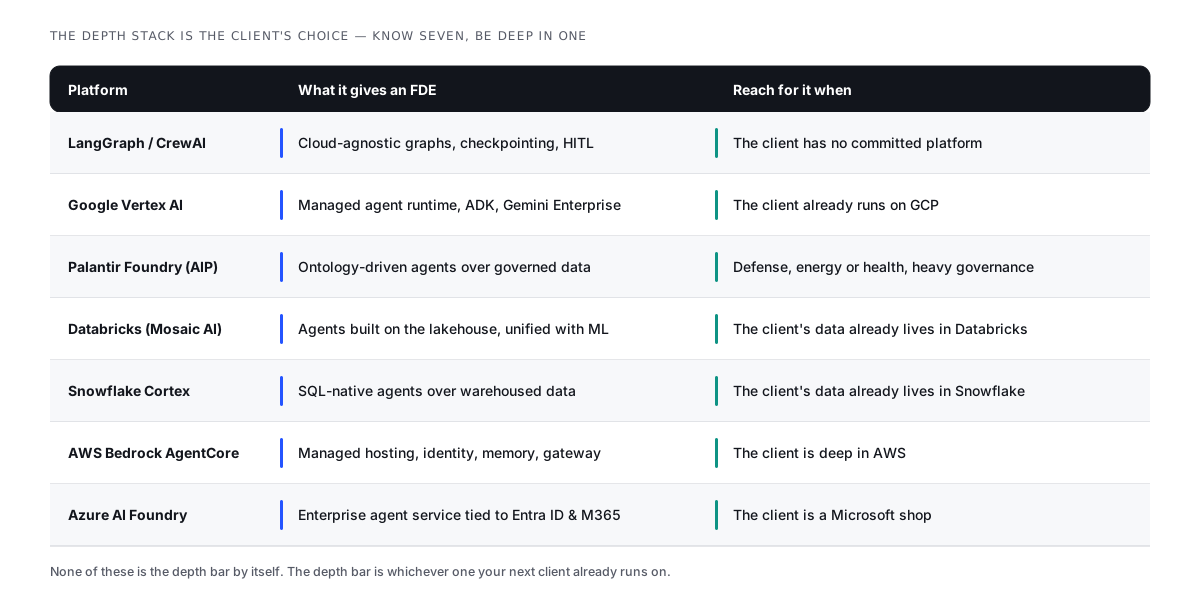
Notice the pattern: five of the seven are a hyperscaler or data platform’s own managed agent runtime, tied to the ecosystem the client has already committed to. LangGraph and CrewAI are the honest exception — cloud-agnostic orchestration for the client who has not committed to a platform yet, or who explicitly wants to avoid lock-in. An FDE who only knows the neutral framework can build a prototype anywhere; an FDE who is also deep in one platform can ship inside the client’s actual production boundary. You need both, but the second one is what the title is really asking for.
A nine-week plan for the depth bar
If the agentic stack is where you need to build real depth, here is a nine-week path — one live project per stage, each shippable in isolation, each assuming the last.
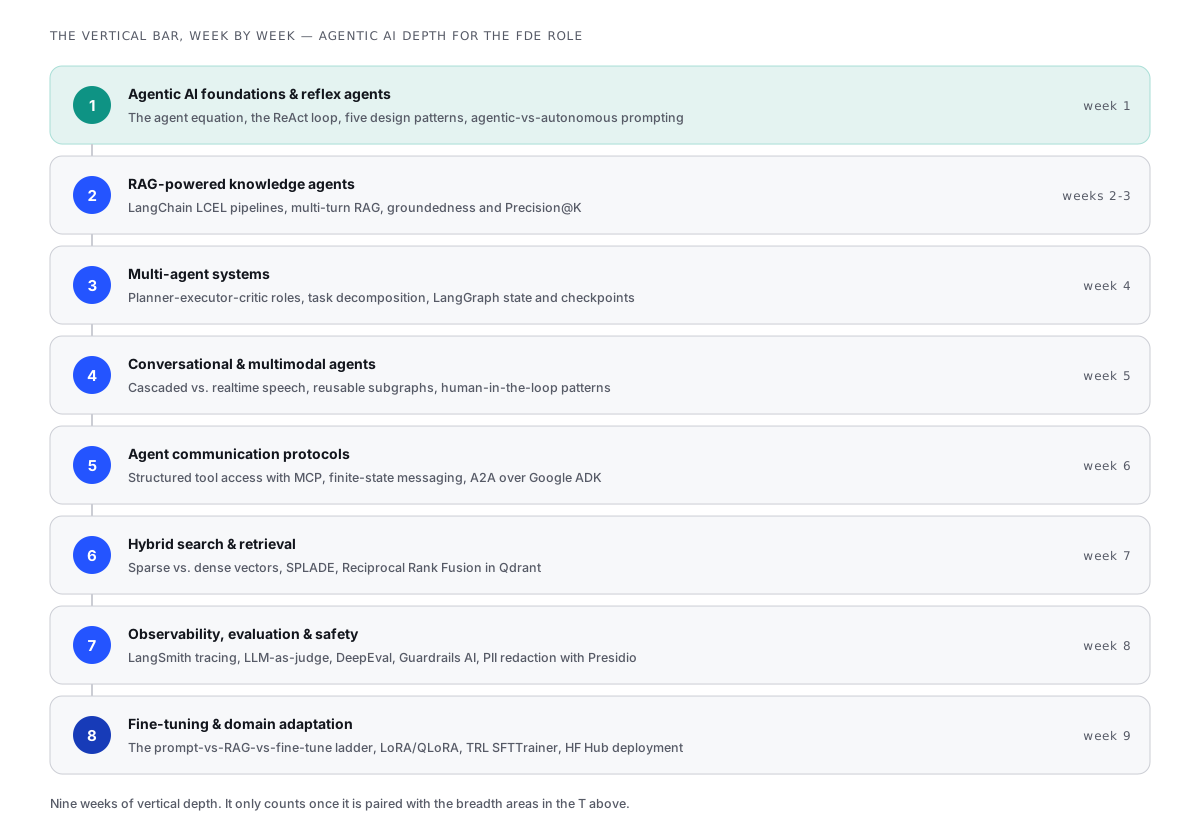
Week 1 — Agentic AI foundations & reflex agents. The agent equation — prompt, tools, memory, and the LLM — the ReAct loop, and the five core agentic design patterns. Learn to tell the difference between agentic and autonomous decision-making before you write a line of orchestration code; most production incidents trace back to a task that should have stayed deterministic getting an agent bolted onto it anyway. Live project: a CRM lead-qualifier agent. Outcome: decide when a task needs an agent — and wire up the first one that works.
Weeks 2–3 — RAG-powered knowledge agents. Retrieve-augment-generate pipelines with LangChain LCEL, multi-turn RAG with conversation history, and hallucination prevention. Measure retrieval and generation separately — Precision@K on the retriever, groundedness on the generator — because a bad RAG system is almost always a bad retrieval system with a confident model papering over it. Live project: a grounded IT support knowledge assistant. Outcome: ship a RAG agent that answers only from its sources and proves it with metrics.
Week 4 — Multi-agent systems (Planner–Executor–Critic). Role-based design — orchestrator, planner, synthesiser — task decomposition, routing and delegation, and LangGraph’s state, nodes, edges and checkpointer persistence. Live project: a multi-agent travel planner. Outcome: split a task that breaks one agent across a team that doesn’t.
Week 5 — Conversational & multimodal agents. Cascaded speech-to-text-to-LLM-to-text-to-speech versus realtime speech-to-speech trade-offs, reusable LangGraph subgraphs for coordination, and human-in-the-loop approve, review-and-edit, and interrupt patterns. Live project: a voice-enabled e-commerce assistant with HITL. Outcome: put a human in the loop without killing the conversation’s UX.
Week 6 — Agent communication protocols (MCP, A2A, ACP). Structured tool access via MCP and FastMCP servers, reliable messaging with finite-state machines and validated transitions, and networked agents over the A2A protocol via Google ADK. Live project: a real-estate negotiation simulator. Outcome: kill the ten failure modes that come from agents talking to each other in free text.
Week 7 — Hybrid search & retrieval. Sparse versus dense vectors, k-NN, ANN and HNSW, SPLADE for learned lexical matching, and hybrid search with Reciprocal Rank Fusion in Qdrant. Live project: a hybrid product search agent combining SPLADE, BGE and RRF. Outcome: beat pure-vector recall by fusing lexical and semantic retrieval.
Week 8 — Agent observability, evaluation & safety. LangSmith tracing and eval datasets built from curated traces, LLM-as-judge and DeepEval metrics, Guardrails AI, and PII redaction with Presidio alongside cost control through routing, caching and batching. Live project: a production-ready fintech support agent. Outcome: cut an agent’s cost-per-query while proving its quality didn’t drop.
Week 9 — Fine-tuning & domain adaptation. The prompt-vs-RAG-vs-fine-tune escalation framework, the PEFT landscape — LoRA, QLoRA, prefix tuning, adapters — 4-bit quantisation, TRL’s SFTTrainer, and deployment to the Hugging Face Hub. Live project: a fine-tuned healthcare Q&A agent. Outcome: know when fine-tuning beats prompting — then train and ship an adapter.
Nine weeks builds the stem. It is still only the stem — pair it with the eight breadth areas above, or you have an engineer who can build an agent and cannot get it past the client’s security review.
What an FDE assessment actually looks for
Enterprise FDE hiring has converged on a shape rather than a checklist. Weight it like this, roughly in order of how often it decides the outcome:
| Signal | What it actually checks |
|---|---|
| Can you ship on someone else’s stack, cold | A take-home or pairing exercise against unfamiliar infrastructure, not a green-field repo |
| Depth in one agentic platform | Whichever of the seven above you name — the interviewer is checking it is real, not that it is the “right” one |
| A discovery conversation, not just a build | Can you turn an ambiguous client ask into a scoped spec in the room, live |
| Composure under a live failure | How you debug when something breaks in front of the person who is paying for it |
| Evidence you closed the feedback loop before | A specific case where a field finding changed a roadmap, not a general claim of “customer obsession” |
The first row is the one people underestimate. It is not testing your algorithms — it is testing whether you can be productive on a client’s undocumented, half-broken environment inside a day, because that is the actual job.
How leading companies actually define the role
None of the above is a guess. Read the FDE and FDE-adjacent postings that Google, Microsoft, AWS, Palantir and OpenAI have on their job portals today and the same T shows up, box for box.
Palantir pioneered the title — Forward Deployed Software Engineer — for people who sit next to a customer, learn the hardest problem in the room, and build the fix on Foundry and AIP themselves. OpenAI’s FDE postings ask for the same shape pointed at frontier models: production-grade front-end and back-end code, several deployments led end to end, and success measured in production adoption, not demo applause. Deloitte and Endava hire Palantir- and Microsoft-focused FDEs by the pod, and their listings are unusually specific about the depth bar — AIP Agents, LLM Functions, and evaluation suites by name, plus the CI/CD, logging, versioning and reusable runbooks that keep a pod’s engagements repeatable rather than bespoke every time. Google’s AI Customer Engineer role reads as the same job again: RAG, text-to-SQL, semantic search and agents on Gemini, sold and scoped in the same conversation. AWS does not use the FDE title, but its Solutions Architect postings ask for the identical pairing — design for the client’s Well-Architected review by day, run the workshop by afternoon.
Two details in those postings are worth pulling into the breadth bar above, because they show up as literal line items rather than implied skills: Model Context Protocol appears by name in Google’s and Microsoft’s listings, not just in this guide’s Week 6 — it has become a hiring signal, not just a pattern. And infrastructure-as-code — Terraform, CloudFormation, Bicep — sits next to containerisation in nearly every FDE posting, which is the concrete version of the Cloud & Containers box above: the client’s stack is not just where you deploy, it’s what you’re expected to script.
The postings also converge on a career-stage version of the T — the vertical bar gets taller as the horizontal bar gets wider, and the years-of-experience bar rises with it.
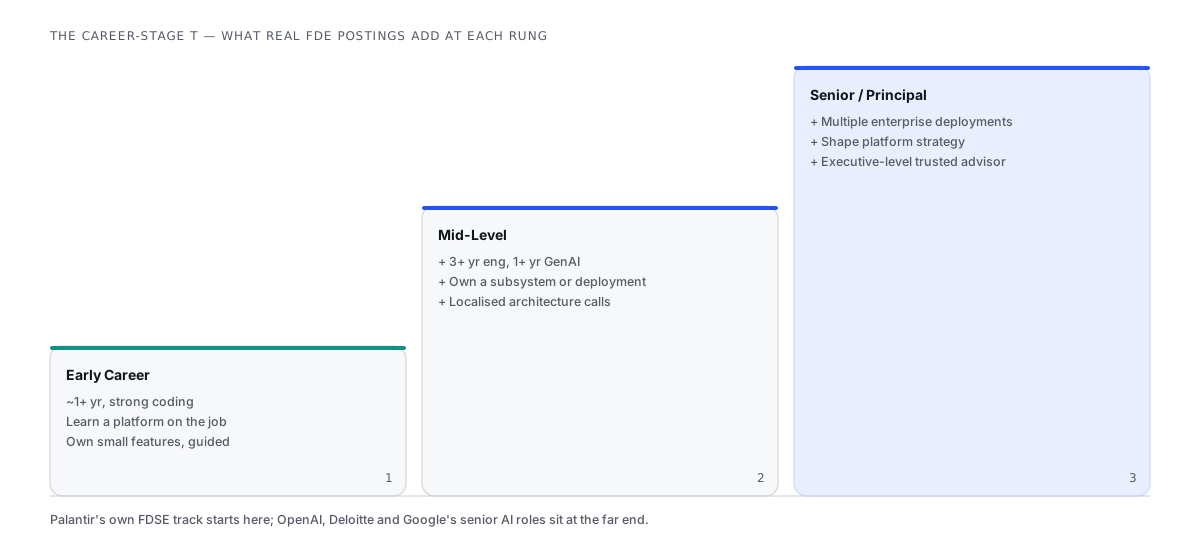
Palantir’s own FDSE track is the most accessible entry point — roughly a year of experience, strong coding, and the learnability to survive a messy customer environment, with a senior FDE alongside you. Deloitte’s and Microsoft’s FDE postings sit a rung up: three-plus years of software, data or AI engineering, at least a year of hands-on GenAI deployment, and ownership of a workstream rather than a single feature. OpenAI’s postings and Google’s senior AI Customer Engineer roles sit at the top rung — years of end-to-end delivery, a track record across multiple enterprise deployments, and enough standing to shape platform strategy and advise an executive directly. Nothing on this ladder replaces the T above; it is the same T, read at three different altitudes.
Where to go next
- ankurkumarz/t-shaped-architect — the maintained skill map this guide draws from
- Java/Python Developer to AI Engineer — the model foundations, RAG and agent stages in full depth, if agentic AI is your first vertical bar
- Developer to Architect: a T-shaped learning path — the breadth bar this one sits alongside, for the solution-architecture side of the FDE role
- Data Engineer to AI Data Engineer — deepen the ETL and retrieval boxes in the breadth bar
- DevOps Engineer to LLMOps/AIOps Platform Engineer — deepen the cloud and crisis-management boxes
- Top agentic AI frameworks to watch — a map of the landscape before you commit to a depth stack
- Building gen AI apps with Snowflake Cortex — one of the seven platforms, in practice