Java/Python Developer to AI Engineer Learning Path
The AI engineer job posting reads like a research role. The actual work is not. It is API calls, retries, schema validation, caching, cost control, tests that fail intermittently, and telemetry — with one component in the middle that returns a different answer every time you call it.
If you are a Java or Python developer, you already have most of the job. What you are missing is a non-deterministic component, and the handful of practices that make it safe to put in production.
This path has seven stages. Roughly nineteen weeks at an hour a day, and it works in either language.
The nine-item checklist
If you only take one thing from this page, take this table. It is the same seven-stage path above, compressed to what you pick, learn and ship at each step, plus where in this article it is covered:
| # | Focus | Learn / tools | Covered in |
|---|---|---|---|
| 1 | LLM fundamentals | Model selection (frontier vs open-source), inference vs training basics, prompt engineering, fine-tuning, embeddings, semantic search, vector databases | Stage 1 |
| 2 | Pick one agent framework | Java: Spring AI, LangChain4j, Google ADK, Embabel · Python: LangChain/LangGraph, CrewAI, PydanticAI, Google ADK | Stage 4 |
| 3 | Agentic design patterns | ReAct, Chain-of-Thought, RAG, state management, orchestration patterns, context engineering | Stages 2–4 |
| 4 | Agent memory management | Short-term vs long-term memory — Mem0, Zep/Graphiti, LangMem | Stage 2 |
| 5 | Agent standards | MCP, A2A, AGENTS.md, SKILLS.md | Stage 4 |
| 6 | Deployment and observability (MELT) | LangSmith, Langfuse, MLflow, Braintrust, AgentOps | Stage 5 |
| 7 | Evaluations and self-improvement | Golden datasets, LLM-as-judge, regression gates, reflection loops | Stage 5 |
| 8 | Vibe coding and productivity tools | Claude Code, Codex, Cursor, GitHub Copilot, Gemini | Stage 0 |
| 9 | Advanced production practices | Guardrails, AI gateways, semantic caching, PII redaction, FinOps | Stage 6 |
Row 2 is the only irreversible-feeling choice, and it isn’t — you can swap frameworks later without redoing rows 3–9, because those are patterns and practices, not vendor lock-in. Get the fundamentals in row 1 solid first, then pick the framework closest to what you already ship and work down the table in order.
Stage 0: what already transfers
Start by discounting the parts you do not need to learn again:
| You already do this | It is called this in AI work |
|---|---|
| Calling an HTTP API with retries and timeouts | Model invocation |
| Validating a response schema | Structured output |
| Caching an expensive call | Prompt and semantic caching |
| Writing integration tests against a flaky dependency | Evaluation |
| Metrics, logs and traces | LLM observability |
| Watching a cloud bill | Token FinOps |
| Modelling a domain | Context engineering |
The gap is narrower than the job titles suggest. What is genuinely new is that the dependency in the middle is probabilistic — so every practice above gets stricter, not looser.
One thing does not transfer, and it is worth naming because it is now an assessed skill in its own right: hands-on use of AI coding tools, sometimes called vibe coding. Claude Code, Codex, Cursor, GitHub Copilot and Gemini are no longer a productivity footnote — being fluent with one of them, and honest about where it fails, is a competency employers check for directly. It also happens to be the fastest way to build intuition about model behaviour, because you watch a model succeed and fail against your own codebase all day. The knowledge base has a section on AI coding agents and a deeper page on Claude Code.
The roadmap
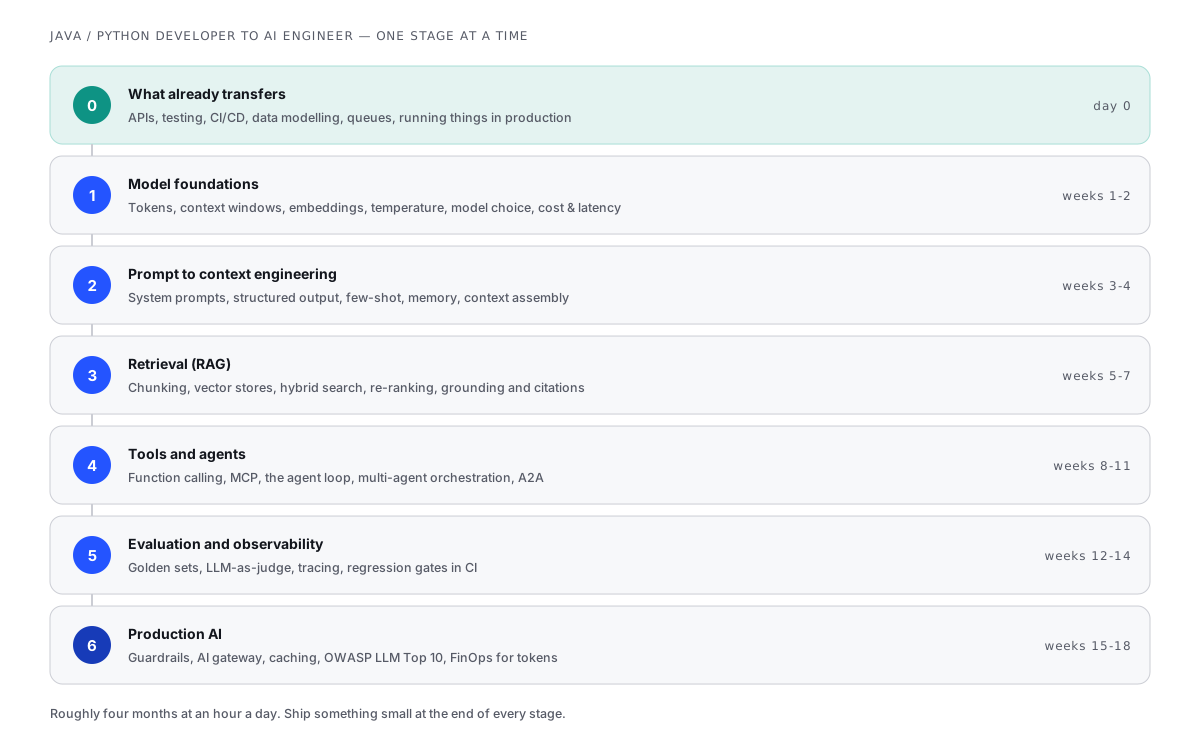
Ship something small at the end of every stage. A stage you have only read about does not count.
Each stage below links into the Agentic AI Knowledge Base — an open, continuously updated reference covering frameworks, standards, patterns, evaluation and production practice. Use this path for the order and the knowledge base for the depth.
What an enterprise assessment actually asks for
Before the stages, it helps to know what you are being measured against. Enterprise AI-engineering assessments have converged on roughly the same eight rows, and they do not all carry the same weight:
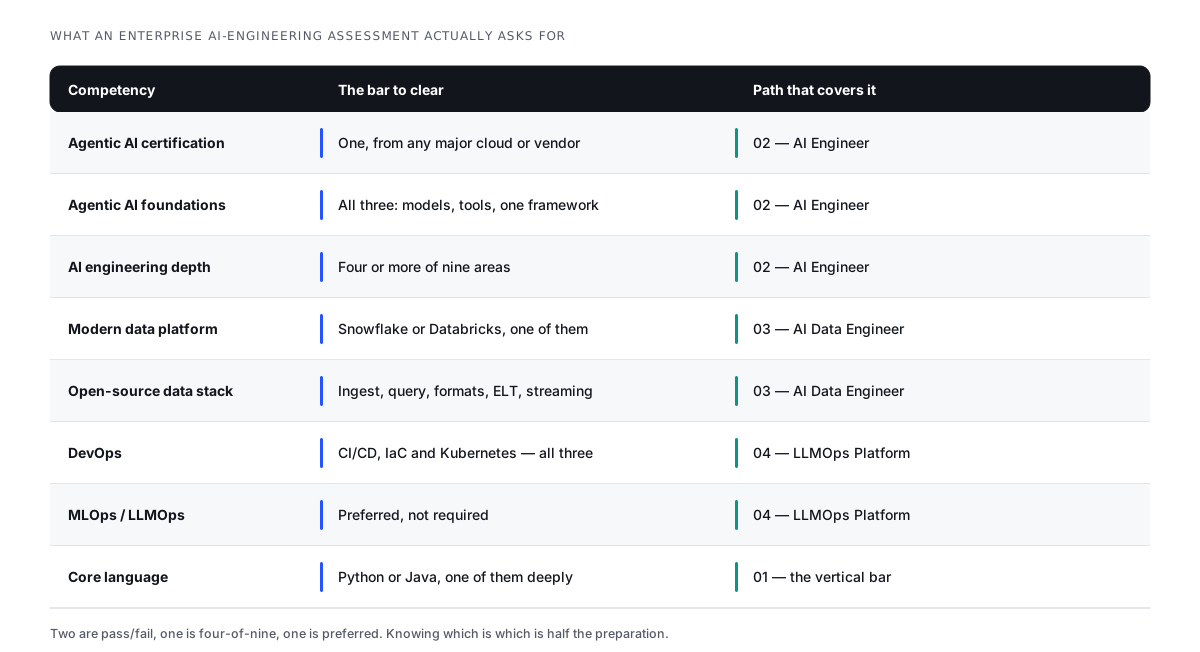
Read the middle column carefully. Two rows are pass/fail — the foundations row wants all three of its areas, the DevOps row wants all three of its. One row is four-of-nine, which means breadth beats depth there. One is explicitly preferred rather than required. Knowing which is which is half the preparation, and it is the part candidates most often get wrong: people go deep on MLOps, which is optional, and skip a certification, which is not.
Stages 1 to 6 below cover the two AI rows. The data platform rows belong to path 03, the DevOps and MLOps rows to path 04, and the core-language row is the vertical bar of the T in path 01.
Stage 1: LLM fundamentals — weeks 1–3
Learn: tokens and tokenisation, context windows, temperature and sampling, streaming, the difference between a base model and an instruction-tuned one, how inference and training actually differ, and how latency and cost scale with input length.
Model selection: frontier versus open-source
Work across at least two frontier families rather than one — Gemini (Pro and Flash), OpenAI’s GPT models, and Anthropic’s Claude models (Opus and Sonnet) differ enough in tool-calling behaviour, structured-output reliability and price-per-capability that a habit formed on one will mislead you on another. Assessments ask about model choice for exactly this reason.
Put an open-source model through the same paces as a frontier one, because “self-host or call an API” is a real architectural decision, not a cost-cutting afterthought: Llama (Meta, the safe general-purpose default), Qwen (Alibaba, strong at multilingual and coding tasks, ships in sizes small enough to run on a laptop) and DeepSeek (notably cheap at strong reasoning quality, and the model most often cited when a team decides self-hosting pencils out). Selection is rarely “which model is smartest” — it is capability versus latency, cost per token, context window, data residency (can this prompt leave your network at all) and fine-tunability, in that order for most enterprise use cases.
Inference and training basics
You do not need to train a model to be effective here, but you do need the vocabulary. Pre-training builds the base model on internet-scale text; instruction tuning and RLHF/RLAIF turn that base model into something that follows instructions and prefers helpful answers; inference is every call you make afterward — the only one of the three most AI engineers ever touch directly. Know what drives inference cost and latency: model size, context length, output length, batching, and whether you are hitting a shared or dedicated endpoint.
Prompt engineering, briefly
A prompt is the interface to all of the above, and it is worth treating as code from day one: version it, test it, and never format user input into a prompt string without escaping it. This stage covers the mechanics — instructions, examples, delimiters, output format. Stage 2 covers the harder problem of what to put in the window, which is where most of the real engineering is.
Fine-tuning
Know when fine-tuning is the right tool and when it is not, because it is reached for too early far more often than too late. Prompting and RAG solve “the model does not know this fact” or “the model does not follow this format” for most cases, and are cheaper and faster to iterate on. Fine-tuning earns its cost when you need a consistent tone or format a prompt cannot pin down reliably, a smaller model to match a larger one’s quality on a narrow task (the main reason to fine-tune in production — it is a cost play, not a capability play), or the model to internalise a large volume of structured examples rather than re-sending them as few-shot context on every call. LoRA and QLoRA are the techniques worth knowing by name — they fine-tune a small adapter on top of frozen model weights, which is why fine-tuning a 7–70B open-source model on a single GPU is now routine rather than exotic.
Embeddings, semantic search and vector databases
An embedding is a numeric vector that places meaning in space, so that semantically similar text ends up geometrically close — this is what makes semantic search possible: matching by meaning rather than keyword overlap. This is foundational, not optional, because it underpins RAG (stage 3), agent memory (stage 2) and re-ranking alike. Get comfortable with cosine similarity, embedding dimensionality, and the fact that different embedding models are not interchangeable — you cannot mix vectors from two models in the same index. Vector databases — pgvector, Pinecone, Weaviate, Milvus — are what makes similarity search fast at scale instead of a brute-force scan; stage 3 covers choosing between them in depth.
Build: a command-line tool that takes a file, summarises it, and prints the token count and cost of the call. Extend it to embed a handful of documents and return the nearest match to a query by cosine similarity.
Done when: you can explain, without hedging, why the same prompt costs twice as much on Tuesday as it did on Monday, and why an embedding from one model is meaningless compared against an embedding from another.
The single most useful habit here is to price everything. Tokens are the unit of cost, latency and quality all at once — engineers who track them make better architectural choices than engineers who do not.
Reference: foundation models, AI engineering concepts and prompt engineering.
Stage 2: prompt to context engineering — weeks 4–5
Prompt engineering is writing a good instruction. Context engineering is deciding what goes into the window at all — which is an architecture problem, and the one this stage is really about.
Learn: system versus user prompts, few-shot examples, structured output and JSON schemas, tool/function definitions as context, short-term versus long-term memory, and context compaction when the window fills.
Build: a classifier that returns a validated object — not a string — and refuses rather than guessing when the input is out of scope.
Done when: your prompts live in version control with tests, not in string literals.
Memory is the part of this stage that has quietly become a product category of its own, and it is worth knowing the options by name rather than writing your own. Mem0 and Graphiti (from Zep) are the open frameworks — Graphiti models memory as a temporal knowledge graph rather than a pile of embeddings, which is what makes “what did this customer tell us last quarter” answerable at all. LangMem is LangChain’s answer if you are already committed to LangGraph — it hooks memory extraction and consolidation directly into the graph’s state rather than bolting on a separate service. Redis has an agent-memory offering worth reaching for if you already run it. Each cloud now ships a managed equivalent: AWS Bedrock AgentCore Memory, Google Vertex AI Memory Bank, and thread state in Azure AI Foundry’s agent service. Choose on where your data already lives. The failure mode here is almost never picking the wrong one — it is hand-rolling a session table, then discovering six months in that nothing can query what the agent remembered.
Reference: context engineering — in particular the common strategies and key challenges — plus prompt engineering and the four memory types.
Stage 3: retrieval, or RAG — weeks 6–8
Learn: chunking strategies and why they matter more than the model, embedding models, vector stores, hybrid search (dense plus keyword), re-ranking, metadata filtering, and citation and grounding so an answer can be checked.
Chunking is where the named techniques live, and they are worth knowing by name because interviewers ask for them: semantic chunking (split on meaning rather than character count), contextual chunking (prepend the document and section context to each chunk so it stands alone), contextual summary (store a generated summary alongside the raw text), context compaction (fold earlier turns down as the window fills) and context rot (the measurable quality decay as a long window fills with marginally relevant material). The knowledge base’s efficiency frontier page covers the cost-performance side of these.
On stores: pgvector is the right first choice if you already run Postgres, and Redis and Elasticsearch if you already run those. Weaviate, Milvus and Pinecone are the dedicated options worth knowing by name and reaching for when scale or hybrid-search features justify a separate system. Add Graph RAG over a graph database such as Neo4j when the questions are about relationships between entities rather than passages of text — that is the case vector search handles worst.
Build: a question-answering service over your own documents that cites its sources and says “I don’t know” when retrieval comes back empty.
Done when: you have measured retrieval quality separately from answer quality. Most bad RAG systems are bad retrieval systems with a good model papering over them.
Reference: RAG implementation and the RAG reference architecture. If the retrieval side is where you want to go deep, that is a path of its own — see Data Engineer to AI Data Engineer.
Stage 4: tools and agents — weeks 9–12
Learn: function and tool calling, the Model Context Protocol for connecting to external systems, the agent loop (plan, act, observe, repeat), stopping conditions and budgets, human-in-the-loop checkpoints, multi-agent orchestration, and agent-to-agent communication.
Three lists are worth committing to memory, because assessments ask for one from each:
| Know one deeply, the rest by name | |
|---|---|
| Frameworks | LangGraph, CrewAI, Google ADK, Microsoft Agent Framework, AWS Strands Agents, LangChain, LlamaIndex, PydanticAI, Spring AI, Embabel |
| Agent platforms | Vertex AI and Gemini Enterprise, AWS Bedrock and AgentCore, Azure AI Foundry, Databricks AgentBricks, Snowflake Cortex |
| Standards | MCP, A2A, AGENTS.md, SKILLS.md, ACP, AG-UI, OKF |
Notice the pattern across the first two rows: every hyperscaler now ships its own agent framework — ADK on Google, Strands on AWS, the Microsoft Agent Framework on Azure — and each is built to land on that cloud’s agent platform in the row below. So learn one framework tied to the cloud you work in, plus one neutral one (LangGraph or CrewAI), and you have covered what an assessment will actually ask about. On the JVM specifically, Spring AI is the safe default if you already run Spring Boot, LangChain4j if you want the closest parity with the Python ecosystem, and Embabel if you want agents modelled as composable Java/Kotlin functions with an explicit planning step rather than a prompt-templated loop.
The patterns matter more than any of them: agentic RAG (the agent decides what to retrieve rather than retrieving once up front), tool calling, multi-agent systems, and reflection — the agent critiques and revises its own output before returning it. Alongside these sits harness engineering: the loop, the context assembly, the tool surface and the stopping rules around the model. That is where most of the engineering actually is, and the knowledge base has a whole section on it — start with harness engineering.
Build: an agent with three real tools — one read, one write, one that can fail — and a hard budget on steps and spend.
Done when: your agent stops. Unbounded loops and runaway spend are the two failure modes that reach production most often.
Our survey of top agentic AI frameworks is a reasonable map of the landscape before you pick one.
Advanced: reasoning strategies
Everything above gets you a working agent. The rest of this stage is the deep end — come back to it once the build runs, because the techniques only make sense against something you have already watched fail.
The reasoning strategies are worth knowing by name and by cost, in roughly the order they were invented:
| Strategy | What it does | Relative cost |
|---|---|---|
| Chain-of-Thought | Produce intermediate steps before the answer | 1× plus the extra tokens |
| Self-consistency | Sample the same question several times, take the majority answer | n× |
| ReAct | Interleave a reasoning step with a tool call, observe, repeat | 1× per loop iteration |
| Tree-of-Thought | Branch into candidate steps, score, prune, backtrack | breadth × depth |
| Graph-of-Thought | Generalises the tree to a graph so branches can merge | breadth × depth |
| Reflection | The agent critiques and revises its own output | 2–3× |
Read that cost column as the whole engineering argument. Tree-of-Thought at breadth 5 and depth 3 is not “a bit more expensive” — it is a search, and a single request can cost twenty to fifty times a plain call and take proportionally longer. That is fine for an offline planning problem and indefensible on an interactive request path.
So the selection rule, which is the part interviews actually probe: reflection when a single answer needs to be better and you can afford one more pass. Self-consistency when the answer is short and checkable — classification, extraction, arithmetic. ReAct whenever tools are in play, which is most of the time; you have already built it, since it is the loop from the Learn list above. Tree-of-Thought only when the problem has a scoreable intermediate state and a genuine search space — constraint satisfaction, puzzle-like planning, code that must pass a test you can run on each branch. If you cannot score a partial solution, a tree gives you nothing a chain would not.
One shift worth being current on: reasoning models now do much of this inside the model, and prompting one to “think step by step” is redundant at best. Explicit Chain-of-Thought has become a technique for cheap models — and for the cases where you need the intermediate steps in your trace to audit them, which a model’s internal reasoning does not give you. Budget reasoning tokens as a first-class cost either way.
Reference: prompt engineering in the knowledge base, and OpenAI’s agentic design patterns for how these compose into a working system.
Advanced: multi-agent workflows
Multi-agent is five topologies, not one, and they carry very different coordination costs:
- Single agent, many tools. The default, and the honest answer to most “we need multiple agents” conversations.
- Sequential pipeline. Fixed order, each stage feeding the next. This is a workflow with model calls in it — no agency, and that is a feature.
- Supervisor or router. One agent decides which specialist handles the turn. The first genuinely multi-agent shape, and the one most systems should stop at.
- Hierarchical. Supervisors of supervisors; a manager decomposes and delegates down a tree.
- Network or peer handoff. Any agent can hand to any other. Most flexible, hardest to bound and to debug.
LangGraph and CrewAI are the two to know hands-on, and the difference between them is real rather than cosmetic. LangGraph models the system as an explicit state graph — nodes are steps, edges are transitions including conditional ones, and a typed state object threads through all of them. What that buys is checkpointing, replay, interrupt-and-resume for human approval, and execution that survives a restart. CrewAI models the same system as roles: agents with a role and a goal, tasks with an expected output, and a sequential or hierarchical process that runs them. Far less code to a working crew. Reach for LangGraph when the workflow is a graph you need to inspect, gate and replay, which describes most production systems; reach for CrewAI when the decomposition really is role-shaped and you want it running this afternoon.
Three things go wrong, and they go wrong in this order:
- Context fragmentation. Every handoff loses what the previous agent knew unless you pass it deliberately — and deciding what to pass is the design problem. This is the most common reason a multi-agent system performs worse than the single agent it replaced.
- Cost and latency multiply. Five agents is five loops. Serial handoffs add latency you never get back, and each one re-reads context somebody already paid for.
- Debugging a system that is non-deterministic twice over — in what each agent says and in where control goes next. Without per-agent spans from stage 5, you are guessing.
Multi-agent genuinely wins in three cases: subtasks that are actually parallel; roles that need different tool and permission scopes, where a read-only researcher and a write-capable executor should not share an identity; and roles that want different models, a cheap one for extraction and an expensive one for synthesis.
Build: take your stage-4 agent, put a supervisor and two specialists in front of it with LangGraph or CrewAI, add a checkpoint you can resume from and a human approval gate on the write tool. Then run it against the single-agent version on the same task set.
Done when: you can say with numbers why your system has more than one agent. If the single agent scores the same, ship the single agent — that is a result, not a failure.
Reference: multi-agent systems, LangGraph and CrewAI in the knowledge base, plus 12-factor agents for keeping any of it operable.
Reference: the knowledge base’s agent development frameworks section covers each one in turn — LangGraph, CrewAI, Google ADK, the Microsoft Agent Framework and Spring AI. For platforms, AWS AgentCore and the agent platforms section. For the standards: MCP, A2A, AGENTS.md, Agent Skills, ACP and OKF. For patterns: OpenAI’s agentic design patterns, multi-agent systems and 12-factor agents.
Advanced: multi-agent architecture — lessons learned
Everything above gets a multi-agent system working. Running one at enterprise scale — across teams, not one project — is a different discipline, closer to platform engineering than prompting. Twelve capabilities keep recurring, and they group into three tiers of maturity.
Makes one system trustworthy — stage 4 and 5 already cover the mechanics; these name the enterprise-grade bar for them:
- Harness engineering — enforced architecture standards, approved design patterns and governance controls across a structured lifecycle: analysis → planning → design → implementation → validation.
- Context engineering and memory management — short-term and long-term memory across procedural, semantic and episodic layers; storage picked per access pattern (vector DB, graph DB, object storage).
- Observability — distributed tracing, trajectory capture, audit logging and replay, for debugging, root-cause analysis and compliance.
- Agent testing — LLM-as-judge, semantic similarity scoring, trajectory evaluation and human review, run as regression, adversarial and continuous-evaluation pipelines.
Governance that only bites past one team — premature centralisation costs as much as skipping it, so add these once a second team ships:
- Agent identity and security — agent-level RBAC, authentication and layered guardrails, scoped to each agent’s data sensitivity and tool access.
- FinOps and cost management — agent-level cost attribution by line of business or team, with chargeback, budgeting and anomaly detection.
- Quota management — token quotas, rate limits and concurrency controls per agent/team/org, plus priority allocation at peak demand.
- Prompt management — centralised prompt versioning, approval workflows, A/B testing, regression detection and rollback.
- AgentOps and DataOps — continuous KPI monitoring (latency, accuracy, tool-call reliability, hallucination rate, cost, data quality) through shared dashboards and feedback loops.
Stops teams rebuilding the same thing:
- Patterns catalog — an approved catalog of orchestrator, router, evaluator-optimizer and fan-out/fan-in patterns, picked per use case rather than reinvented per team.
- Shared capabilities — one enterprise framework for RAG, agentic RAG and GraphRAG behind a unified LLM gateway, instead of siloed reimplementations.
- Fault tolerance and resiliency — circuit breakers and dynamic routing across LLM providers on availability, cost or latency. Cheap to build early; the one everyone skips until the first outage.
Reference: 12-factor agents and multi-agent systems for the architecture, agent observability and production best practices for the operational rows.
Stage 5: evaluation and observability — weeks 13–15
This is the stage that separates an AI engineer from someone who has been to a workshop.
Learn: golden datasets, offline versus online evaluation, LLM-as-judge and its biases, regression gates in CI, tracing a multi-step call, and the metrics that matter — groundedness, relevance, latency, cost per resolved request.
The tooling splits in two, and assessments expect one from each side. Evaluation: RAGAS for retrieval-augmented systems, DeepEval, MLflow’s evaluation support, Galileo, Braintrust. Observability: Langfuse, LangSmith, AgentOps, or whatever your organisation already runs with OpenTelemetry underneath — think MELT (metrics, events, logs, traces) rather than logging alone, since a single bad turn is usually a trace-level problem, not a log line. Pick one of each and use them on a real system rather than collecting names.
Build: an evaluation suite of fifty cases that runs in your pipeline and fails the build when quality drops.
Done when: you can change the model behind your application and know within ten minutes whether it got better or worse.
Reference: evaluation frameworks, AI as a judge, agent benchmarks and agent observability.
Stage 6: production AI — weeks 16–19
Learn: guardrails and content safety, prompt injection and the OWASP Top 10 for LLM applications, an AI gateway for routing, rate limiting and fallback, semantic caching, PII redaction, audit trails, and token-level FinOps.
Build: put one of your earlier projects behind a gateway with guardrails, caching, tracing and a monthly budget, and run it for real users.
Done when: someone other than you depends on it and you sleep fine.
The agentic reference architecture covers the enterprise-scale version of this picture — gateway and trust layer, orchestration, grounding services, model catalogues and the data plane underneath.
Reference: production best practices — security, deployment, cost management — plus security frameworks and NIST AI RMF. If running this platform is the part that interests you, that is also a path of its own — see DevOps Engineer to LLMOps/AIOps Platform Engineer.
The certification row
The first row of the matrix is the one people skip, and it is pass/fail. Most enterprise assessments want one certification, from any credible vendor — the point is a verified baseline, not the badge. Pick the one closest to the cloud you already work in and treat it as a deadline rather than a subject:
| Credential | Suits you if |
|---|---|
| Google Generative AI Leader | You want the broad, vendor-framed overview fastest |
| AWS Certified Generative AI Developer – Professional | You build on AWS and want the deepest hands-on option |
| Anthropic Claude Certified — Associate Foundations (CCAO-F), Architect Foundations (CCAR-F), Architect Professional (CCAR-P), Developer Foundations (CCDV-F) | You want a model-vendor track with separate developer and architect ladders |
| Snowflake or Databricks generative AI credentials | Your organisation’s AI work sits on its data platform |
Time it for the end of stage 4. Earlier and the material is abstract; later and you are revising things you already do daily. If you want the exam-preparation pattern that works, the same discipline as acing the CKA applies here — schedule the exam first, then work backwards.
Same architecture, two ecosystems
You do not have to move to Python. The patterns are identical; only the imports change.
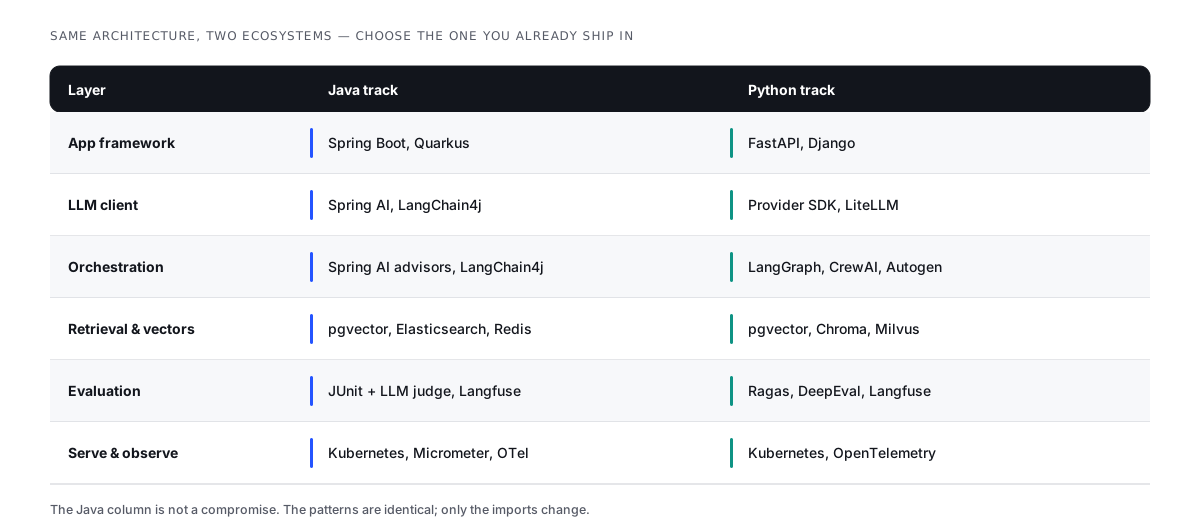
For the Java side specifically, building intelligent applications with LangChain4j walks through the same building blocks with Spring Boot and Quarkus.
Pick the column you already ship in. Enterprise AI work lands where the enterprise data and the enterprise services already are, and for a great many organisations that is the JVM. Learning Python and AI engineering at the same time doubles the work and halves the depth.
What to have built by the end
Four projects, in order. Each one reuses the last:
| # | Project | Proves you can |
|---|---|---|
| 1 | Structured extraction service | Get reliable, typed output from a probabilistic component |
| 2 | Grounded Q&A over private documents | Build and measure a retrieval pipeline |
| 3 | Tool-using agent with a budget | Design an agent loop that terminates and can be audited |
| 4 | One of the above, in production | Ship it with guardrails, evals, tracing and a cost ceiling |
Project four is the portfolio. The first three are practice.
Five traps worth naming
- Chasing models instead of building systems. The model will change three times while you build. The retrieval, evaluation and guardrails you write around it will not.
- Skipping evaluation until “later”. Without a baseline you cannot tell an improvement from a regression, and every change becomes an argument.
- Treating RAG as solved. Chunking and re-ranking decide the answer quality far more often than the model does.
- Agents where a function would do. If the sequence of steps is known in advance, write the workflow. An agent is for when it is not.
- Ignoring cost until the invoice. Cost per resolved request is a design constraint, the same as latency. Measure it from week one.
Where to go next
- Agentic AI Knowledge Base — the open reference behind the per-stage links above, covering frameworks, standards, context engineering, memory, evaluation, observability, security and maturity models. Start with the recommendation wizard if you want it to point you somewhere.
- Building intelligent applications with LangChain4j and Java frameworks
- Top agentic AI frameworks to watch
- Elevate your AI journey with Amazon Bedrock
- Building gen AI apps with Snowflake Cortex
- Data Engineer to AI Data Engineer — the retrieval and semantic layer underneath
- DevOps Engineer to LLMOps/AIOps Platform Engineer — the platform this runs on
- Developer to Architect: a T-shaped learning path — the breadth this path sits inside