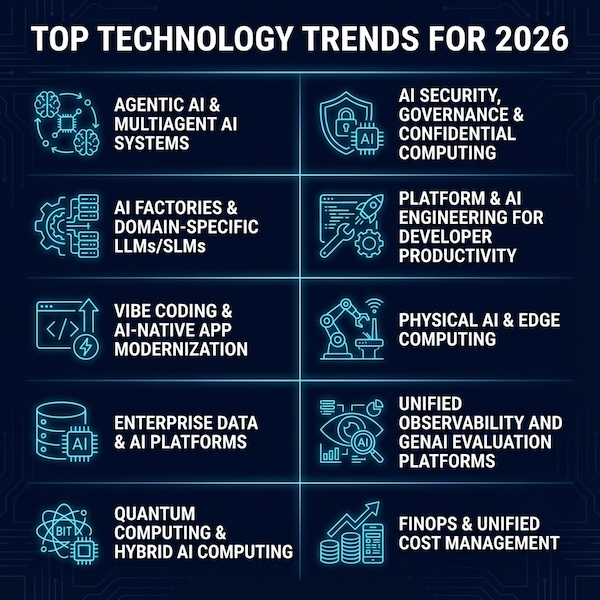
Top Ten Technology Trends for 2026
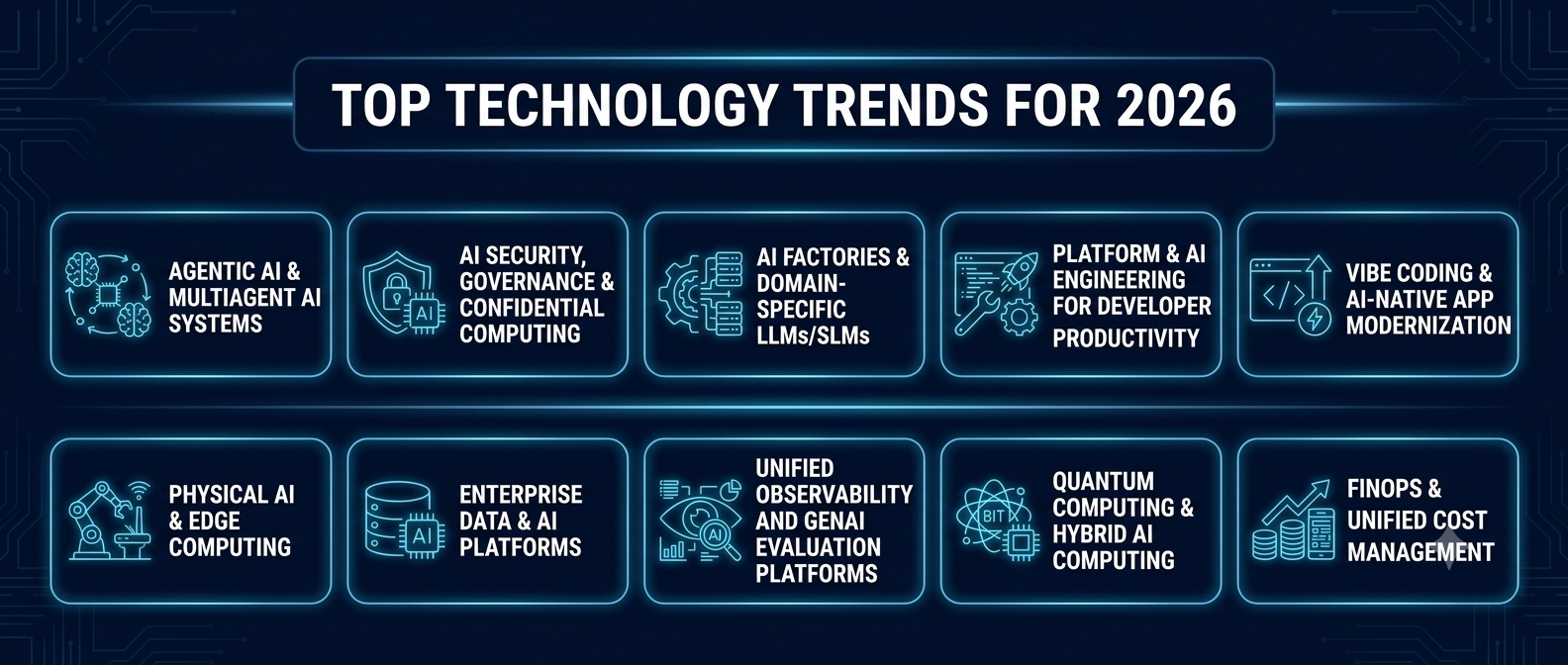
Observing technology trends through the lens of analysts, research organizations, thought leaders, and personal research creates awareness and helps build a broader perspective and shape your point of view.
This article highlights the top ten technology trends for 2026 and beyond based on my broader research, technology insights, industry experience, and observations of emerging technology patterns. Click on the corresponding links to read about the technology trends published for 2025, 2024, 2023, 2022, and 2021.
#1 — Agentic AI and Multiagent AI Systems
15% of day-to-day work decisions will be made autonomously by 2028 (up from 0% in 2024); 40% of enterprise apps will embed task-specific agents by 2026. — Gartner
50% of new economic value from digital businesses by 2030 will come from AI capabilities; 45% of organizations will orchestrate AI agents at scale. — IDC
Key Trends and Opportunities
- Evolution towards Production-ready Agentic Apps: The experimentation phase provided its early momentum — in 2026, we’ll see production-ready agentic applications focused on measurable business value, Service-Level Objectives (SLOs), and Service-Level Agreements (SLAs). Agentic AI applications will continue to move beyond pilots to real-world production applications in 2026. For example, SRE and Operations self-learning AI Agents handling L1/L2 scenarios based on real-world scenarios, Customer Onboarding AI Agents driven by business workflows, Customer Service AI Agents that not only assist clients but also take autonomous actions, Lead Generation AI Agents autonomously prioritizing and planning based on business-driven use cases, Security, Performance, or DevOps AI Agents that identify, recommend, and implement remediations (as needed), and many more.
- Agentic AI as the Default Application Layer: As newer models such as Google Gemini 3, OpenAI GPT-5.2, and Claude Sonnet 4.5 target cost-effective and reliable reasoning for domain-specific agents, Agentic AI as an architectural pattern will continue to evolve in 2026. Autonomous task management, workflow automation, orchestration, and embedded copilots across horizontal (productivity, dev tools) and vertical (healthcare, finance, retail) solutions will continue to grow in the coming years, with Agentic AI serving as a core enabler.
- Lessons Learned and Proven Architecture & Design Patterns: Lessons learned from real-world production challenges will continue to surface and shape implementations through 2026 — progression from Prompt Engineering towards Context Engineering, Memory Management Patterns (such as Short-term/Working Memory and Long-term/Semantic Memory), evolution of database systems to provide Vector Storage and Semantic Search capabilities, security guardrails built into cloud-provider services and integrated with agentic frameworks, an evaluation-first development mindset applying a shift-left approach, and many more patterns emerging as lessons shared by the industry.
2025 has seen the arrival of agents that can do real cognitive work; writing computer code will never be the same. 2026 will likely see the arrival of systems that can figure out novel insights. 2027 may see the arrival of robots that can do tasks in the real world. — Sam Altman (CEO, OpenAI)
- AI Agents Move Beyond Chat: The pivotal shift from simple RAG or facade layers on top of frontier models to domain-driven agentic workflows will continue in 2026, accelerating both innovative startups and bespoke enterprise solutions. Vertical agents, augmented with proprietary enterprise data, are emerging as key differentiators according to industry leaders. In addition, ROI-driven AI Agents will become a key priority for engineering leaders in 2026, prioritized by top-down strategy direction.
- Multi-agent AI Systems (MAS) to Evolve: Considering the complexity of enterprise applications, multi-agent systems using a collection of specialized AI agents with the power of agentic workflow will continue to evolve in 2026. Multi-vendor bespoke enterprise platforms, alongside cloud-provider- and product-company-driven out-of-the-box solutions, will reach mainstream adoption. In practical terms, building multi-agent systems is still in an early adoption stage where core design patterns are being formulated — how agents communicate with each other and what protocol to use, how authorization (RBAC) between agents is structured, how many agents to build and what’s the appropriate number of tools to map to each, how context is passed between agents while managing agent memory efficiently, how agents are monitored, and so on.
- Agent Engineering as a New Discipline: As the LangChain community shares its perspective, the evolution towards Agent Engineering is expected to gain momentum in 2026. As defined by LangChain, “Agent Engineering is an iterative process of refining non-deterministic LLM systems into reliable production experiences. It is a cyclical process: build, test, ship, observe, refine, repeat.”
- Agent Standards Will Continue to Evolve in 2026: 2025 witnessed various standards related to agents evolve, such as the Model Context Protocol for context engineering and connectivity to external systems, Agent-to-Agent as a standard designed to enable communication and collaboration between AI agents, AGENTS.md for documentation guiding coding agents, A2UI for AI agents to generate rich, interactive user interfaces, Agent Client Protocol to standardize communication between code editors/IDEs and coding agents, Agentic Commerce Protocol (ACP) as a standard enabling conversation between buyers and their AI agents, and Agent Payments Protocol (AP2) as a protocol enabling agent commerce for developers, merchants, and the payments industry. 2026 has already started with the announcement of another protocol by Google — Universal Commerce Protocol for agentic commerce, enabling journeys between consumer surfaces, businesses, and payment providers.
The AI arms race is over. Agentic AI will win. The future isn’t bigger LLMs. It’s agentic workflows — reflection, planning, tool use, and multi-agent collaboration. — Andrew Ng (Founder of DeepLearning.AI and Co-founder of Coursera)
Key Areas To Watch For
- Preventing Architecture Chaos: With increased productivity in code generation using AI agents, Enterprise Architecture teams need to ensure that guardrails, standards, and governance prevail to maintain consistency, compliance, and efficiency. For example, applying human-in-the-loop review (mapped to architect personas such as Security Architect, Performance Architect, Enterprise Architect, etc.) for key architectural decisions during application development and modernization is becoming a de facto standard for enterprise governance.
- Monitoring Technical Debt and Code Slop: With the accelerating pace of code generation by AI agents and AI coding assistants, there is a growing risk of increased code-review backlogs, particularly where human review is required by enterprise standards or processes. Code slop represents a significant risk, as reviewers may need to spend considerable time assessing AI-generated code — whether generated by their teams or AI agents — that isn’t meaningful, contextual, or aligned with the production-grade quality they expect.
AI slop (code slop specifically for AI Coding Agents) is digital content or code made with generative artificial intelligence, specifically when perceived to show a lack of effort, quality or deeper meaning, and an overwhelming volume of production. — Wikipedia
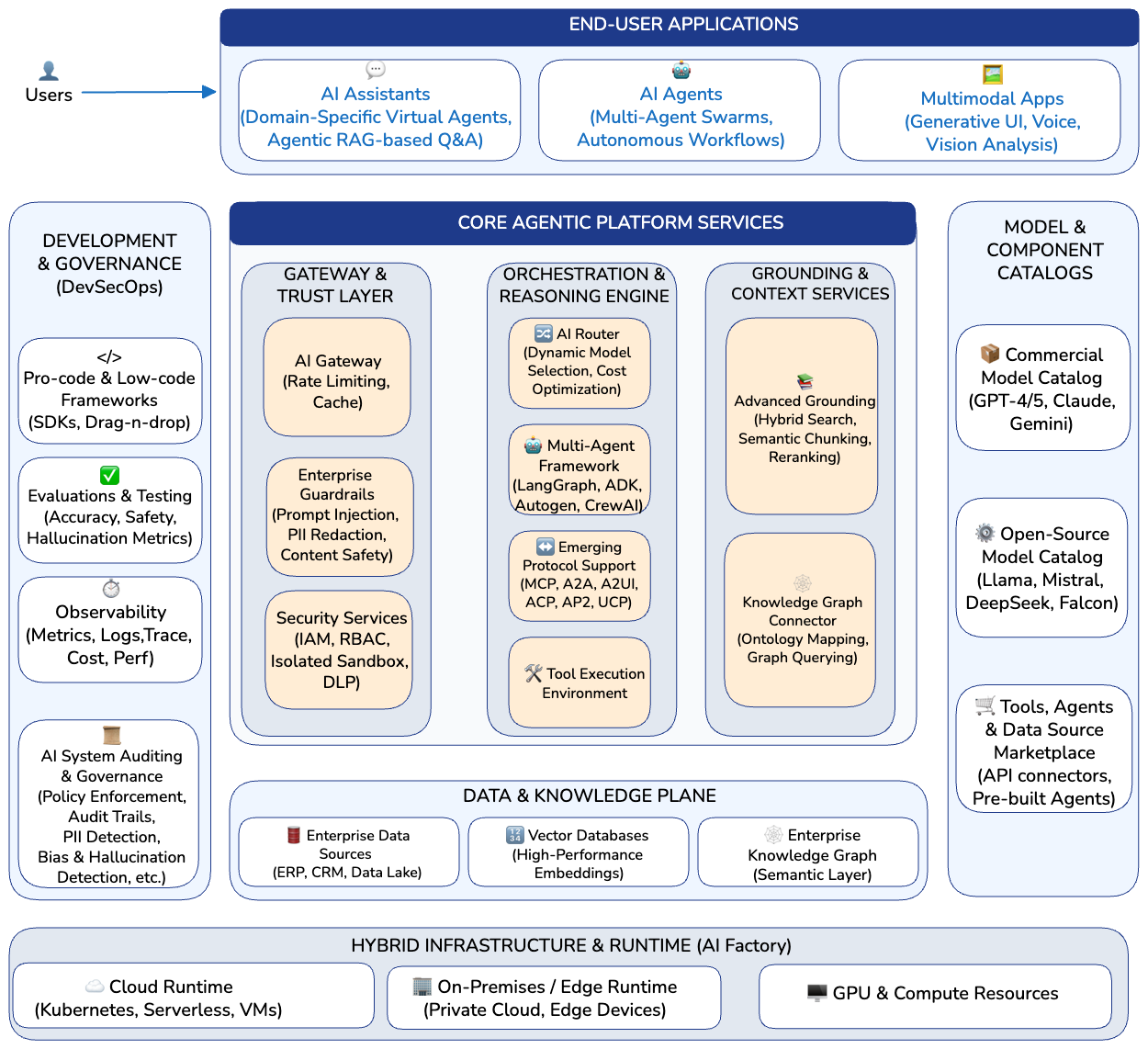
Agentic Reference Architecture with Core Building Blocks in an Enterprise Ecosystem
While the enterprise context drives the architecture formulation, this reference architecture provides key foundational building blocks to consider for current- and future-state gap analysis:
#2 — AI Factories and Domain-specific LLMs/SLMs
AI factory is a specialized computing infrastructure where raw data is transformed into intelligence. These facilities operate like industrial assembly lines for artificial intelligence, generating AI tokens (the “raw material” of intelligence) which can become language, images, predictions, or robotic instructions. — Jensen Huang (Founder, President and CEO, NVIDIA)
Key Trends and Opportunities
- Every Company Becoming an AI Company: Beyond NVIDIA’s predictions, industry leaders have envisioned that most enterprises are either building or planning to build their own AI factories — from GPU chips to end-to-end AI infrastructure. AI factories are emerging as a key differentiator, with tokenization becoming common vocabulary that’s relevant not only for hyperscalers but also for enterprises, enabling and accelerating business capabilities driven by generative AI.
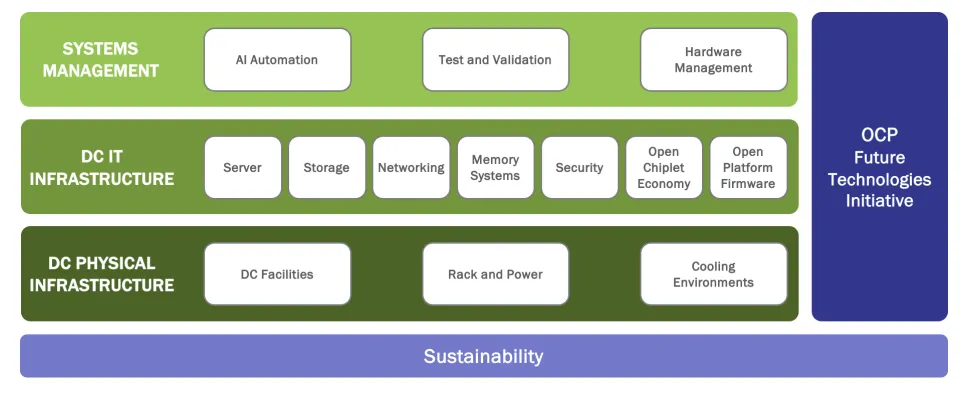
- AI Infrastructure with Open & Interoperable Standards: NVIDIA led the evolution of GPU chips — Ampere (A100) → Hopper (H100) → Hopper-Refresh (H200) → Blackwell (B100/B200) → Rubin — and related infrastructure components such as connectivity (NVLink, NVSwitch, InfiniBand, Ethernet), systems (DGX, HGX), memory (HBM), storage (NVMe, parallel FS), software (CUDA, cuDNN, Triton, TensorRT), orchestration (Kubernetes), MLOps/LLMOps/AIOps, observability, and power & cooling (liquid cooling). Established in 2011, The Open Compute Project (OCP) is evolving as a community-driven initiative to build open and interoperable solutions for gigawatt-scale AI factories, focusing on modular server designs, high-density power and cooling solutions, and high-performance networking (see the Open Systems for AI: Blueprint for Scalable Infrastructure whitepaper).
- Optimizing Strategies for LLM Pre- and Post-Training: Scaling laws will continue to be optimized in 2026 broadly across three phases: pre-training, leveraging large-scale compute for petabyte-scale data corpora; post-training, addressing the surge in training demand for domain-specific Supervised Fine-tuning (SFT) and Reinforcement Learning (RL); and the thinking phase, where the focus shifts toward scaling inference-time compute to enable advanced reasoning capabilities.
- Continuation of Open-source Models as Frontier Models: As proprietary models reach maturity in terms of parameter scale and context size, 2026 will continue to witness saturation in proprietary model offerings, while open-source models move closer to proprietary models such as Gemini, GPT, and Claude. Open-source models — including Llama, Mixtral, GPT-OSS, DeepSeek, Qwen, Gemma, Falcon, and others — are emerging as strong alternatives and will be increasingly preferred by enterprises seeking to build specialized models using their own proprietary data and enterprise infrastructure.
- Emergence of Domain-specific Language Models (DSLMs): In continuation of the above point, Gartner predicts that over 60% of enterprise GenAI models will be domain-specific by 2028. In 2026, enterprise-specific technology strategies and roadmaps will increasingly include initiatives aligned with domain-specific language models, hosted on cloud providers, neoclouds, or on-premises, targeted at transforming organizations into AI-driven, forward-looking enterprises. These domain-specific models don’t necessarily need to be large language models — small language models (SLMs) can be better suited for specific scenarios, particularly when generality isn’t required.
AI is an industrial bubble as opposed to a financial bubble, but society will get gigantic benefits from the tech when the dust settles. Today we talk about AI-first companies (Mistral, OpenAI, Anthropic), but the biggest impact is AI is going to impact every company in the world. — Jeff Bezos (Founder, Amazon)
Key Areas To Watch For
- AI Bubble and the Risks of Overinvestment and Over-Reliance: As a precautionary measure, AI initiatives should be driven by ROI and supported by strong business cases. While there is a race to acquire GPUs and build AI data centers, investments need to be rationalized to avoid overcommitment and ensure AI efforts remain sustainable and value-driven. Enterprise governance measures should be in place to provide the necessary guardrails to address these risks.
- Consolidation and Convergence of Vendor Technologies: With the proliferation of cloud products (LLMs, SLMs, agentic platforms, AI services, AI assistants, AI agents, and more), vendor technology consolidation is predictable. Enterprises should ensure their technology strategy isn’t overly dependent on specific vendors, and that their AI factory and LLM strategy remains flexible and future-ready to address these evolving dynamics in 2026.
#3 — Vibe Coding & AI-native App Modernization
There’s a new kind of coding I call “vibe coding,” where you fully give in to the vibes, embrace exponentials, and forget that the code even exists. It’s possible because the LLMs (e.g., Cursor Composer with Sonnet) are getting too good. — Andrej Karpathy (Previously Director of AI at Tesla, Founding team at OpenAI, PhD Stanford)
Key Trends and Opportunities
- English (or Any Natural Language) as a Programming Language: From high-level programming languages to AI coding assistants, we are witnessing a new generation of programming — using English (as prompts) to build applications with vibe coding techniques. This opens up new possibilities as it expands development communities beyond traditional programmers, making everyone a potential software developer. On the other hand, while it’s exciting to build prototype apps with minimal coding experience, there is still a long way to go to build production-grade apps with just prompts. Applying design patterns, a systems-design mindset, and T-shaped knowledge will continue to play a larger role in building complex enterprise-grade systems.
- Accelerated Legacy & Application Modernization with AI Agents: As AI agents mature with specification-driven development targeting the end-to-end SDLC, organizations will accelerate legacy application modernization initiatives with a new era of solutions built largely by AI. Product companies, hyperscalers, and system-integration and consulting companies have developed their own versions of legacy modernization solutions, such as Azure Migrate, AWS Amazon Q Developer and AWS Transform, Mainframe Modernization with Gemini, IBM watsonx Code Assistant, Claude Code, vFunction, and more.
- Rise of AI-native Development Platforms: Gartner® Magic Quadrant™ for AI Application Development Platforms highlights the leading solutions in this space, reflecting the growing maturity of platforms purpose-built for AI-native development.
- Vibe Coding is an Art and a Science: Gene Kim and Steve Yegge introduced the concept of five dimensions — FAAFO: fast, ambitious, autonomous, fun, and optionality. While AI-first app-building solutions such as Lovable, Cursor AI, Bolt, Repl.it, GitHub Copilot, Devin, Claude Code, Google Antigravity, Amazon Kiro, OpenAI Codex, Cline, Augment Code, Qodo, and many more provide compelling vibe coding capabilities, leveraging these technologies is a structured process similar to PDCA (plan – do – check – act, an iterative management approach), requiring the engineering rigor needed to achieve the desired outcome.
- The Era of Renaissance Developers: Werner Vogels offers insightful guidance on how developers can remain relevant, with key traits such as curiosity, a systems mindset, communication, ownership, and a polymath approach. Continuous learning and development in an AI-native world is the best mantra for developers to elevate their presence in enterprise environments. Refer to this GitHub repository for a T-shaped Architect with GenAI skillset.
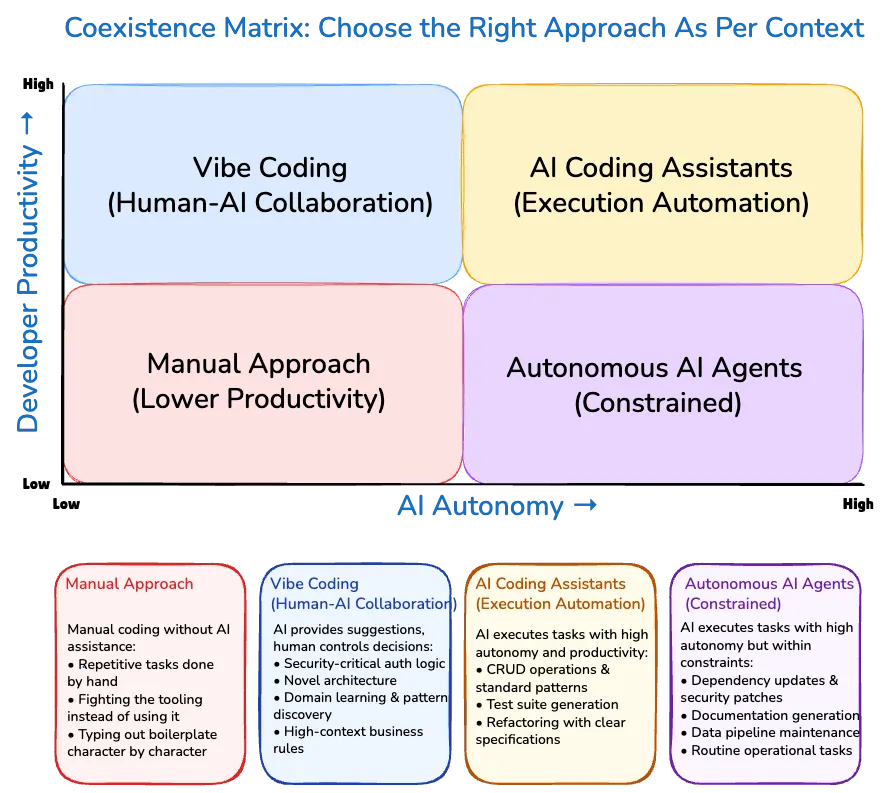
Vibe Coding, AI Agent, AI Coding Assistant — A Decision Matrix
Key Areas To Watch For
By 2027, at least 30% of application security exposures will result from usage of vibe coding practices. — Gartner
- Risks with AI-generated Code: With the accelerated pace of code generation driven by AI coding assistants, there is a growing risk of security vulnerabilities expanding the attack surface. This demands higher maturity across DevSecOps and SDLC practices to mitigate security risks at a similar pace, including the opportunity to use AI security agents to address these challenges.
- Novel Nature & Maturity of Vibe Coding Practices: Considering the novelty of the vibe coding approach, there are risks in terms of owning AI-generated code in production environments. There are doubts and a diverse set of perspectives with respect to enterprise-specific maturity, the complexity of system integration, organizational data and knowledge context, and applying lessons learned when code is entirely AI-generated.
#4 — Enterprise Data and AI Platforms
Every future company, or even startups currently being formed, will build upon a Data and AI foundation rather than the siloed, complex architectures of the past. — Ali Ghodsi (Co-founder and CEO, Databricks)
Key Trends and Opportunities
- Convergence of Enterprise Data Platforms and AI Platforms: Enterprise data platforms and AI platforms are converging, with the boundaries between them increasingly diminishing, leading towards a unified solution. Most data platforms have started offering generative AI capabilities by bringing AI closer to the data, and AI platforms are similarly moving data closer to AI by providing data connectors — a trend that will continue in 2026. This convergence creates opportunities for enterprises to unify their on-premises or cloud data warehouses and data lakes with AI and machine learning solutions. For example, Snowflake Cortex, Google BigQuery, Databricks, Oracle AI Database, and similar solutions bring AI closer to the data by embedding it directly into the data platform — through AI SQL functions for LLM access, AI-powered business intelligence, AI assistants for text-to-SQL, semantic search with vector embeddings, automated data pipelines with data quality checks, in-database machine learning, built-in AI research and AI agents, MCP server support, and more.
- Data Has Emerged as the Next Competitive Advantage: The next big wave of the generative AI revolution is training LLMs, or applying context engineering through the Agentic RAG pattern, on private data residing in enterprise systems. Building robust data pipelines for AI agents with embedded quality checks for improved response quality, and automating embedding generation on data stored in enterprise systems, will continue to emerge as key priorities for enterprises in 2026. The potential to unlock insights from enterprise data sources will be the next competitive advantage for enterprises building bespoke generative AI offerings for their respective business domains. Enterprises are adopting the concept of a data economy, offering Data-as-a-Service to monetize their datasets and turn information into revenue-generating assets.
- The Rise of Data Intelligence Platforms with a Data-as-a-Product Mindset: Augmenting domain-driven design, Data-as-a-Product is now in mainstream adoption and will continue to mature as a practice in 2026, enabling enterprises to position data as a key differentiator. Organizations will continue to move away from fragmented data architecture towards data intelligence platforms with Data-as-a-Product as an enabler. A primary objective of these platforms is the democratization of data, where natural language becomes the new programming language for developers and a new interface for business teams — freeing them from a fixed set of BI dashboards.
- Context Engineering as a Key Enabler: With context relevance and effective usage of context emerging as one of the key design patterns, context engineering as a discipline will continue to gain traction for building effective agents in 2026. Offload context, context compaction, cache context, isolate context, and other novel patterns have emerged as best practices shared by developers of coding agents such as Claude, Manus, LangChain, Devin, Gemini, and more.
Context engineering is the delicate art and science of filling the context window with just the right information for the next step. — Andrej Karpathy
Key Areas To Watch For
- Vendor Consolidation and the Associated Impact: Considering the evolving convergence of data and AI platforms, 2025 witnessed vendor consolidation — such as IBM’s acquisition of Confluent to strengthen their smart data platform, Snowflake’s plan to acquire Observe to expand AI offerings, Salesforce’s acquisition of Informatica to accelerate their agentic AI data platform, CoreWeave’s acquisition of Weights & Biases to expand AI workflow integration, and Fivetran’s acquisition of dbt Labs to advance open data infrastructure for analytics and AI, among others. In 2026, the trend of vendor consolidation will continue as data and AI capabilities become increasingly integrated. Enterprises will need to be prepared to address these dynamics by designing their systems in a vendor-neutral way or by establishing an appropriate abstraction layer.
- Security Concerns and Limitations Due to Data Entropy: As defined by a16z, “Data entropy is the steady decay of freshness, structure, and truth within the vast unstructured universe where 80% of corporate knowledge now resides.” Additionally, ensuring that confidential data isn’t exposed to AI systems, through appropriate authentication and authorization guardrails, will remain a critical data security concern to watch for in 2026.
#5 — Quantum Computing & Hybrid AI Computing
AI supercomputers to run Quantum GPU applications. Quantum computing won’t replace classical systems. They will work together, fused into one accelerated quantum supercomputing platform. — Jensen Huang (Founder and CEO, NVIDIA)
Key Trends and Opportunities
- Rise of Pragmatic Opportunities with Quantum Computing & Hybrid AI: Quantum computing is transitioning from theoretical research to a pragmatic, high-performance compute architecture through integration with AI platforms. NVIDIA, Amazon, Google, Microsoft, and other leading industry players have pioneered initiatives combining AI with quantum computing. In 2026, hyperscalers are expected to continue enriching their quantum computing services, providing production-grade capabilities for their clients. 2026 is being framed as the start of “quantum industrialization,” with CPUs, GPUs, and quantum processing units operating together in multimodal data-center architectures — moving away from quantum as a standalone solution. Amazon currently provides a fully managed quantum cloud service in Amazon Braket, Microsoft offers Azure Quantum as its quantum platform, and Google provides Quantum AI as a research-focused quantum compute platform. Innovations such as NVIDIA’s NVQLink, designed to bridge the gap between quantum and GPU computing, are expected to continue emerging in 2026.
- Post-Quantum Cybersecurity Standards and Tools: Standards and tools have started to emerge to address the possibility of cybersecurity attacks using quantum-enabled technologies. NIST has published three encryption standards: FIPS 203 for encryption standards, FIPS 204 for protecting digital signatures, and FIPS 205 for digital signatures. Threat modeling and related CISO practices will start prioritizing security and the adoption of a new set of tools and technologies for the future in 2026.
- Adoption of Quantum Programming Languages and Quantum SDKs: Enterprises will start exploring and experimenting with quantum programming languages and frameworks such as XACC, ProjectQ, and Google’s Cirq, and quantum SDKs such as IBM’s Qiskit, Azure Quantum Development Kit, Amazon Braket SDK, NVIDIA cuQuantum, Intel Quantum SDK, and more.
- Applicability of Generative AI and Quantum Computing as Collaborative Technologies: While there are many overlapping opportunities, generative AI and quantum computing aren’t isolated or competitive technologies. AI supercomputing platforms feature both GPU architecture and quantum-computing-based architectural paradigms, along with quantum processors, providing a unified computing environment. Furthermore, industry research is applying generative AI (AI agents, and more) to increase efficiency in the context of quantum computing network and resource allocation, as illustrated below:
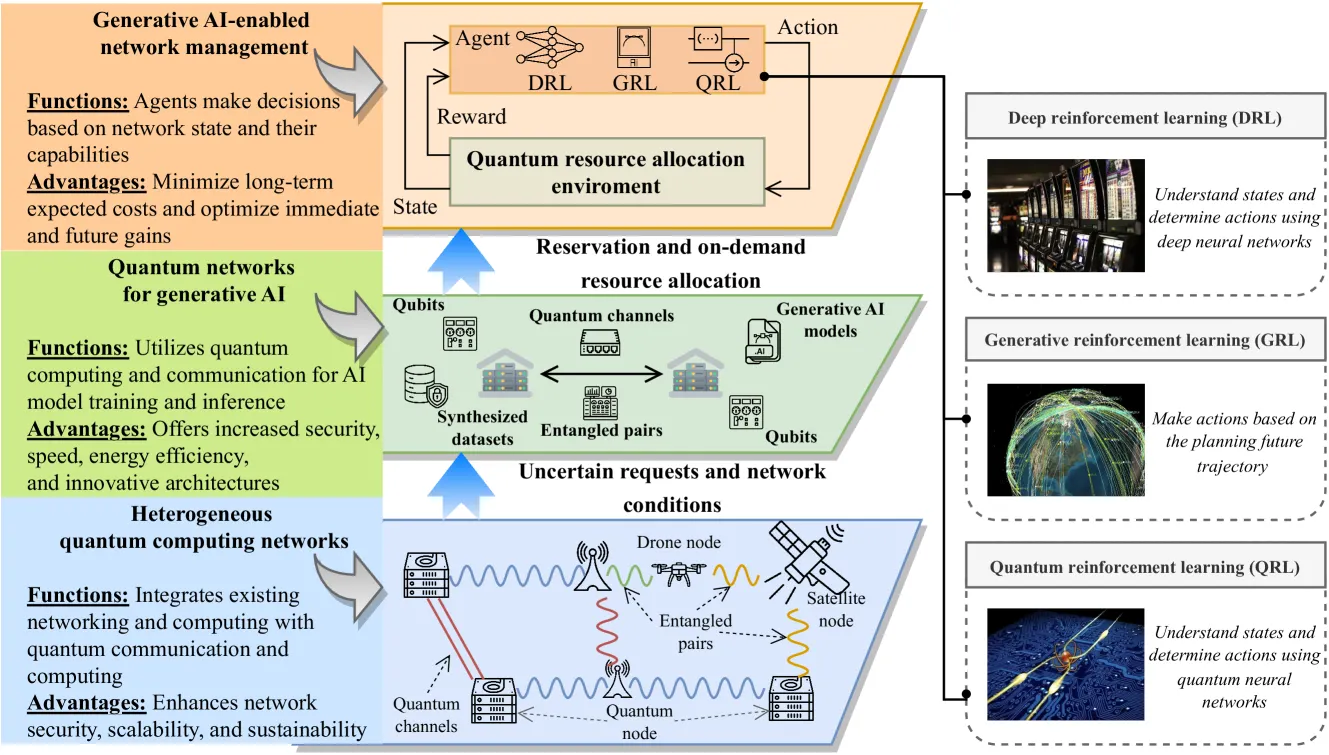
Source: arxiv.org/html/2401.07120v1
#6 — AI Security, Governance, and Confidential Computing
By 2027, at least 30% of application security exposures will result from usage of vibe coding practices. — Gartner
Key Trends and Opportunities
- Rise of Security AI Agents and Automated Security Operations: From security product companies to hyperscalers, the focus has shifted to creating reusable, customizable AI security agents offered as an out-of-the-box capability. In 2026, AI security agents will mature further, providing customized capabilities for enterprises along with earlier adoption. Organizations will not only have the opportunity to use vendor-specific security agents but will also continue to develop custom AI security agents to meet internal requirements driven by organization-specific threat models and security guardrail frameworks.
- Unified Control Plane for Security & Governance of AI Agents: With the rise of AI agents and their related ecosystem — including models, vector databases, observability, and memory management — centralized enterprise security will continue to be a priority for CISO teams in 2026. An enterprise governance approach, supported by a unified control plane providing a single pane of glass for security threats and mitigation, continues to be a focus area in 2026.
- Incremental Adoption of Confidential Computing: Confidential computing uses hardware-based trusted execution to protect data during processing. While it has been on the radar for financial services companies, the increasing risk of AI-based attacks will accelerate adoption of confidential computing in 2026. It isn’t limited to CPUs — GPU computing has also started adopting it, with GPU Confidential Computing (GPU-CC) introduced as part of the NVIDIA Hopper Architecture. Read the whitepaper here.
Confidential computing uses hardware-based trusted execution environments to protect data while it’s being processed, preventing unauthorized access. 75% of processing in untrusted infrastructure will be secured by confidential computing by 2029. — Gartner
#7 — Platform and AI Engineering for Developer Productivity
The dawn of the renaissance developer — tools change, but the fundamentals endure. As generative AI reshapes how we build software, a familiar trope has re-emerged: the narrative that developers will become obsolete. But if history has taught us anything, this is not the end of the developer, it’s the dawn of something new — the renaissance developer. — Dr. Werner Vogels (VP & CTO, Amazon.com)
Key Trends and Opportunities
- Platform Engineering Solutions as a Productivity Enabler: In 2026, everything beyond agent and application development will be abstracted to the portfolio level through centralized platforms, effectively decoupling development (the core focus for business capabilities) from operational concerns (e.g., compute/network/storage management, cloud services enablement and provisioned-throughput management, dynamic quota handling, model security, observability, evaluation, etc.). Architecture decisions, documented as ADRs, need to be established for high-impact choices — such as selecting between a managed-provider platform (e.g., Google Vertex AI, Amazon Bedrock, or Azure Foundry) versus building a custom or hybrid enterprise AI platform in-house.
- Augmentation of DevSecOps with GenAI-driven Platform Engineering: Generative AI is expanding beyond code generation into platform engineering activities, including CI/CD pipelines, infrastructure-as-code generation (e.g., Terraform, Ansible, Pulumi), automated software quality checks (performance, security, code quality, etc.), and more. The infusion of generative AI into DevSecOps practices will continue to expand in 2026 and has been predicted as one of the leading technology initiatives on engineering leaders’ radar (see illustration below):
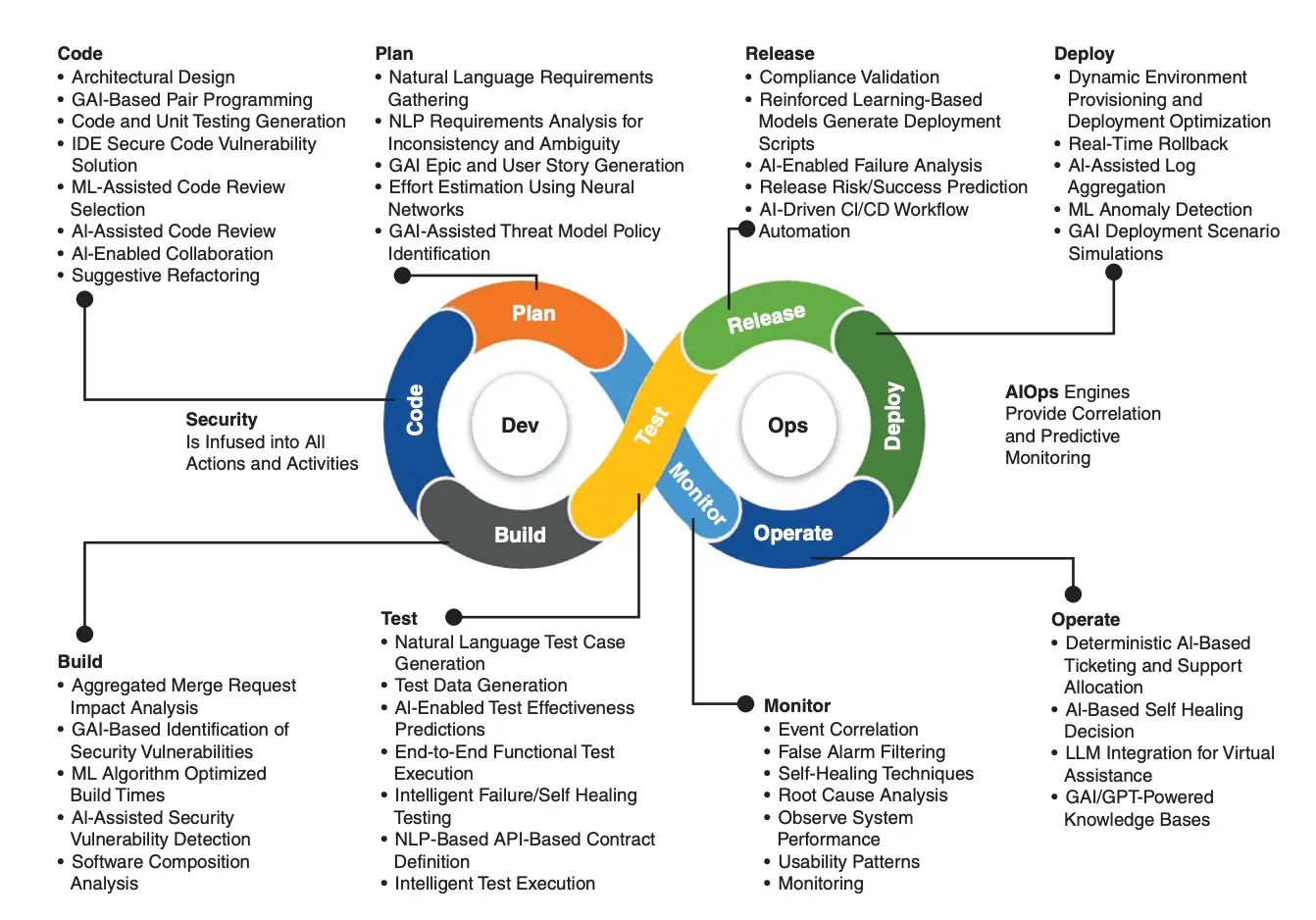
Source: T. T. Bannon, IEEE Computer, Sept. 2024
- Unified GPU-as-a-Service (GPUaaS) as an Abstraction Layer: By 2026, platform engineering teams will focus on enabling an enterprise-level delivery model that provides on-demand, consumption-based, metered access to GPU compute — abstracted from the underlying infrastructure, whether on-premises, hyperscalers (GCP, AWS, Azure), or neoclouds (CoreWeave, Lambda, Crusoe, RunPod, etc.).
- System Scalability, Availability, Reliability, and Performance to Support AI Agents’ Workload: The increasing workload on existing systems will come not from human users but, according to industry experts, exponentially more from AI agents. Thousands of running AI agents will send millions of requests to existing architectural layers such as API gateways, microservices, databases, APIs, and legacy applications, raising expectations for SLOs and SLAs across existing systems. Platform engineering and application development teams need to start preparing for this additional workload — while AI agents can help accelerate continuous development and deployment, “time to market” expectations will only increase further in 2026.
#8 — Physical AI & Edge Computing
Physical AI for industrial and robotics is a $50 trillion opportunity — AI-powered robotics and automation are set to transform manufacturing, logistics, healthcare and other industries. — Jensen Huang (NVIDIA CEO), GTC 2025
Key Trends and Opportunities
- Rise of Embedded and Physical AI: Intelligence is being built directly into devices, machines, and environments — from industrial robots and autonomous systems to connected sensors — allowing real-time learning and adaptation at the edge. IDC predicts that by 2030, 50% of enterprise AI inference workloads will be processed locally on endpoints or edge nodes.
- Shift-Left Momentum of Reasoning Capabilities Towards Edge Devices: Compact, high-reasoning models like Falcon-H1R and NVIDIA’s Alpamayo show small, efficient systems addressing math, coding, and autonomous driving. Leading companies such as NVIDIA, AMD, Google, and Intel have ramped up their AI accelerators at the edge-device level, and this momentum will continue into 2026 across devices such as mobile phones, TVs, home devices, automobiles, robots, and more. At CES, the majority of exhibited products centered around AI-centric hardware and “Physical AI,” clearly signaling the direction of future technology trends. IT teams will need to focus in 2026 on optimizing data latency, enabling faster local model inference, advancing efficient distributed AI engineering, and standardizing the edge AI software stack to prepare for this shift.
Gartner has predicted that half of the top AI vendors will offer physical AI products by 2028, and 80% of warehouses will use robotics or automation by the same year.
#9 — Unified Observability and GenAI Evaluation Platforms
Key Trends and Opportunities
- Enterprise Architecture Maturity Towards a “Single Pane of Glass” Across Applications, Data, Infrastructure, Agents, and LLMs: The applicability of a “single pane of glass” at the enterprise level — spanning applications (microservices, APIs), data platforms, infrastructure, agents, and LLM/end-to-end observability — has been a continuous journey. Organizations have faced several challenges, including technical complexity, limited support for component-level monitoring in legacy systems, difficulty consolidating telemetry data across cloud-native and hybrid (cloud and on-premises) architectures, and inconsistent MELT (Metrics, Events, Logs, Traces) enablement across the technology stack. While enterprises vary in maturity, generative AI and the AI agents ecosystem have added a new set of AI-first observability platforms, such as LangSmith, Arize AI, Braintrust, Langfuse, AgentOps, MLFlow, and more. Incumbent players such as Dynatrace, Datadog, New Relic, Splunk, Elastic, and Sumo Logic have also accelerated their offerings to provide unified observability platforms with AI-driven capabilities.
- Adoption of Hybrid Unified Observability at the Enterprise Level: Pragmatically, most enterprises are adopting a hybrid unified observability approach combining vendor solutions, custom or open-source stacks (such as Grafana, Prometheus, and the ELK stack), cloud-provider monitoring services, and specialized observability solutions for agents or integrated solutions embedded in their technology layer (for example, Databricks’ or Snowflake’s native monitoring approach). In 2026, enterprises will continue making progress toward maturing observability across this diverse set of technologies.
- Rise of LLM and Agentic AI Applications’ Observability and a New Set of Metrics: In continuation of end-to-end observability, LLM and agentic AI observability provides enhanced tracing, monitoring, diagnostics, and troubleshooting. Improving AI agents’ behavior and operational effectiveness, balancing non-functional aspects (cost, quality, performance, security, etc.), and proactively remediating production issues will be embedded into observability platforms. A new set of metrics — such as Time to First Token, Provisioned Throughput Unit (PTU), tokens throughput at the enterprise/project level, anomaly detection rate, and agent/LLM/model usage — will emerge as key KPIs for enterprises to track in 2026.
Focus on performance metrics/KPIs linked to reliability/uptime, accuracy of task completion, and continuous performance improvement to maximize the value of agent assets. — IDC FutureScape 2026
- Rising Relevance and Integration of LLM and AI Agent Evaluation within Enterprises: While many industry-level benchmarks exist for evaluating LLMs and AI agents, enterprise-specific evaluation platforms built on internal enterprise datasets will become a key focus area in 2026. Organizations will continue to define custom internal benchmarks and measure agentic applications using metrics such as fluency, coherence, response quality, accuracy, explainability, tool trajectories, and relevance.
#10 — FinOps and Unified Cost Management for AI
By 2027, 75% of organizations will combine GenAI with FinOps processes to improve the intelligence of DevOps pipelines and optimize costs before going into production. — IDC FutureScape
Key Trends and Opportunities
- Unified View of Cost at the Enterprise Level, Applying FinOps Practices: Converging total cost of ownership (TCO) into a unified view at the enterprise level will continue to be a key focus area for executive stakeholders in 2026. Applying industry-standard practices and the FinOps Foundation framework will continue to be a key priority for enterprise architects, and adoption of standards such as FOCUS (the FinOps Open Cost and Usage Specification) will accelerate in 2026.
FOCUS is an open specification that defines clear requirements for technology billing data generators to produce consistent cost and usage datasets.
- AI Agents Cost Analysis and Reporting: In 2026, AI agents and shadow agents will continue to grow, requiring FinOps teams to report cost metrics at the level of individual AI agents. Considering the evolving nature of the agentic technology stack, several challenges remain to be addressed, including component-level cost tracking across agents, vector and memory databases, cloud services, and LLM inference.
To extend the technology trends list further, the following technologies are also important to watch for:
- Artificial General Intelligence (AGI): a system that can tackle increasingly complex problems, at a human level, across many fields.
- Sustainable computing: energy-efficient hardware, intelligent resource management, and renewable energy, while scaling sustainability practices.
- Space computing: reliable, autonomous computing for deep-space missions.
- Spatial computing: blending the physical and digital worlds.
- Data feudalism: empowering users to regain control over their data.
- AI regulations: harmonized global standards for AI ethics and governance.
- Digital provenance: verification of the origin and integrity of software, data, and media using a variety of novel solutions.
- Neuromorphic computing/engineering: an approach to computing that mimics the way the human brain works.
- Green computing and sustainability.
- Miscellaneous: Chaos Engineering, Green Software Engineering, Modular Monolith, Generative Design AI, Design Systems, Event-driven Architecture, DesignOps, Threat Modeling Automation, etc.
To conclude, these technology trends for 2026 will continue to have a significant presence in modern enterprises’ technology strategy, driven by organizational functional and non-functional objectives.
References:
- Gartner Top 10 Strategic Technology Trends for 2026
- Forrester Predictions 2026: Technology and Security
- Werner Vogels’ Tech Predictions for 2026 and Beyond
- IDC FutureScape 2026 IT Industry Predictions
- Publicis Sapient’s Guide to Next 2026
- Google AI Agent Trends 2026
- NVIDIA GTC Washington, D.C. Keynote with CEO Jensen Huang
- Technology Radar by ThoughtWorks (Vol 33 — Nov 2025)
- State of AI Report (2025)
- Stack Overflow Developer Survey 2025
- InfoQ Trends Reports (Cloud & DevOps, Software Architecture & Design, and AI, ML, and Data Engineering)
- Google’s Year in Review: 8 Areas with Research Breakthroughs in 2025
- Anthropic: The 2026 State of AI Agents Report
- OpenAI: The State of Enterprise AI
- Microsoft: What’s Next in AI — 7 Trends to Watch in 2026
- NVIDIA GTC Washington, D.C. Keynote 2025
- Andreessen Horowitz (a16z) Big Ideas 2026
- Y Combinator Startups 2025
- Databricks: Big Book of Data Engineering, Big Book of GenAI
- Snowflake AI + Data Predictions 2026
- LangChain: State of AI Agents Report
- Sequoia AI 50: AI Agents Move Beyond Chat
- Larry Ellison Keynote on Oracle’s Vision and Strategy: Oracle AI World 2025
- Salesforce’s Dreamforce Keynote 2025
- The War of Slop by Swyx
Disclaimer:
All data and information provided on this blog are for informational purposes only. The author makes no representations as to the accuracy, completeness, correctness, suitability, or validity of any information on this blog and will not be liable for any errors, omissions, or delays in this information or any losses, injuries, or damages arising from its display or use. This is a personal view and the opinions expressed here represent my own and not those of my employer or any other organization.