Modern Data and AI Platform Architecture (2026)
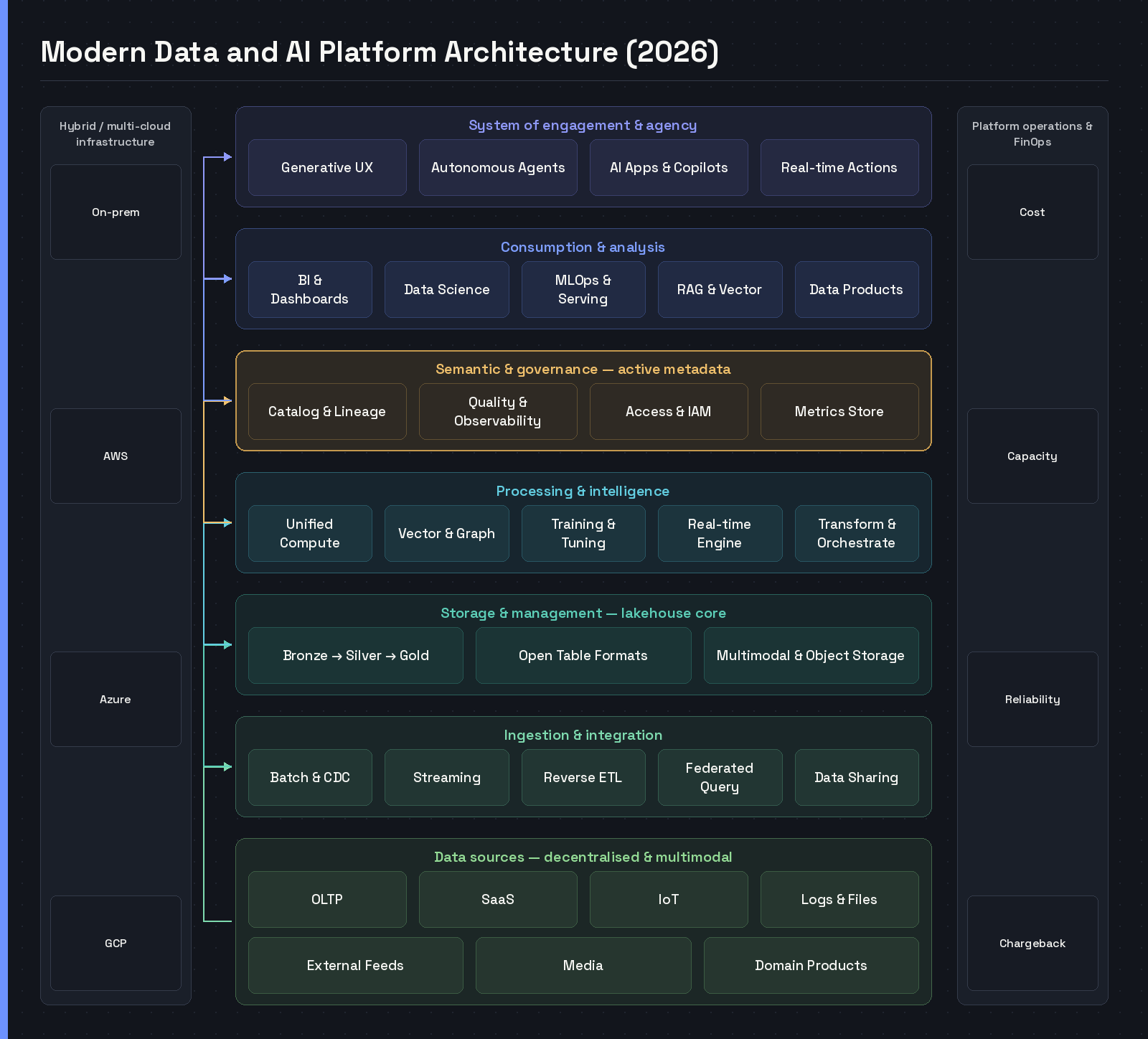
A seven-layer reference architecture for a modern data and AI platform — sources through lakehouse, semantics and agents, on hybrid multi-cloud.
The challenge
Running analytics, machine learning and generative AI on one platform rather than three — without the semantic layer, the governance model or the cost story being bolted on afterwards.
Most enterprises arrive at 2026 with three platforms: a warehouse for analytics, a separate stack for machine learning, and something newer bolted on for generative AI. Each has its own copy of the data, its own access model and its own idea of what a customer is. This modern architecture is the consolidation of those three onto one substrate.
How it works
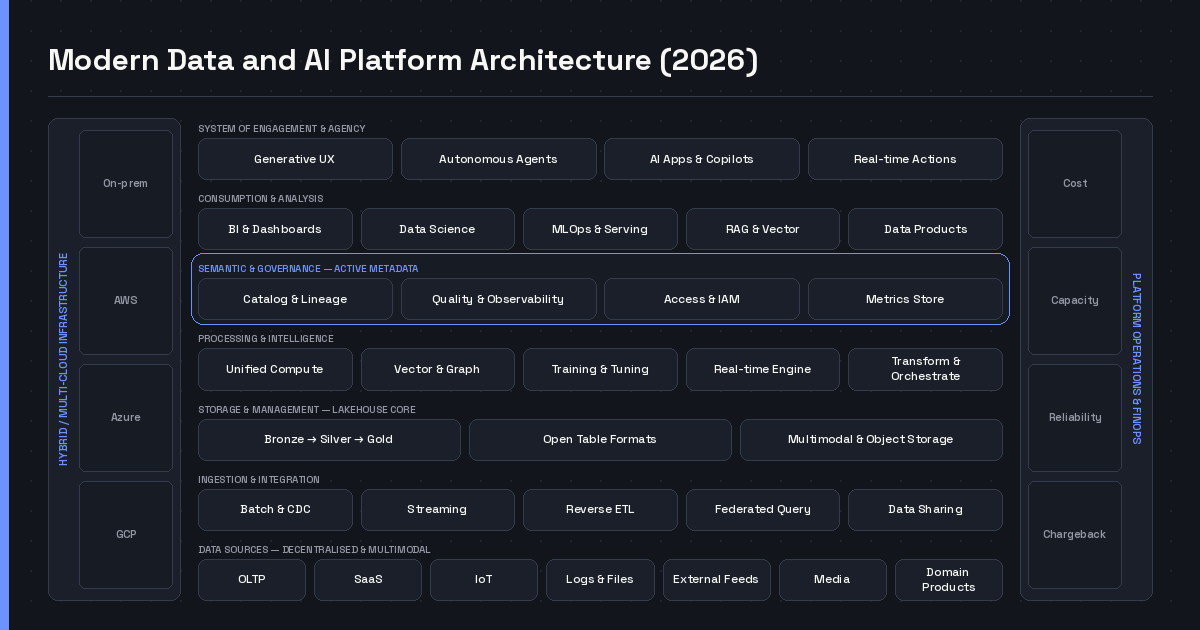
Read bottom-up. Decentralised, multimodal sources feed an ingestion layer that deliberately offers four routes — batch and CDC, streaming, federated query for data that should not move, and sharing for data that crosses an organisational boundary. Choosing per-source rather than standardising on one is what keeps the platform from copying everything by default.
The lakehouse core is the single copy. The medallion progression takes raw bronze to refined silver to curated gold, on open table formats so that the processing layer above — Spark, a real-time engine, a training job, a vector index — can all read the same physical files without another extract.
Above processing, the semantic and governance layer is what makes this one platform rather than a shared disk. Catalogue, lineage, quality, access control and the metrics store are described as active metadata because they are enforced at query time rather than published as documentation. Consumption and the agentic layer above both go through it.
The two rails matter as much as the stack. Hybrid and multi-cloud infrastructure runs underneath everything, which is the reason the storage layer commits to open formats. Platform operations and FinOps run alongside everything, because on an AI platform the cost of GPUs and of careless queries is a design constraint rather than a monthly surprise.
What to get right
- One copy of the data, many engines. The moment a team needs its own extract to go fast, the governance model has a hole in it.
- Active metadata, not a catalogue nobody reads. If the semantic layer is not in the query path, it is documentation, and it will drift.
- Decide the agentic layer’s blast radius early. Autonomous agents that can act need scoped credentials, budgets and an audit trail before they ship, not after the first incident.
- FinOps from day one. Retrofitting chargeback onto a platform that has already trained everyone to run unbounded queries is a political problem, not a technical one.
- Open formats are the exit. They are what makes the hybrid and multi-cloud rail real rather than aspirational.
How it fits together
System of engagement and agency
Generative UX, autonomous agents, AI applications and copilots, and real-time insight-to-action. The top layer acts on the platform rather than only reporting from it.
Consumption and analysis
BI and dashboards, data science workbenches, MLOps and model serving, AI services such as RAG and vector search, and data products exposed as APIs.
Semantic and governance layer (active metadata)
Unified catalogue and lineage, data quality and observability, access control and IAM, and the business semantics and metrics store. Active metadata means it drives behaviour, not just documents it.
Processing and intelligence
Unified batch and streaming compute, vector databases and knowledge graphs, model training and fine-tuning, a real-time analytics engine, and transformation and orchestration.
Storage and management (lakehouse core)
The medallion progression from bronze raw to silver refined to gold curated, on open table formats — Delta Lake, Iceberg, Hudi — over multimodal and object storage.
Ingestion and integration
Batch ingestion and CDC, real-time streaming, reverse ETL back into operational systems, federated querying for what should not move, and data sharing or marketplace distribution.
Data sources (decentralised and multimodal)
OLTP databases, SaaS applications, IoT and sensors, logs and files, external feeds, media, and domain-owned data products from other teams.
Hybrid and multi-cloud infrastructure rail
On-premises and multiple clouds beneath every layer, which is why storage sits on open formats and compute is portable rather than assuming one provider.
Platform operations and FinOps rail
Cost visibility, capacity, reliability and chargeback, running the full height. GPU and query spend is an architectural constraint on an AI platform, not an afterthought.
Typically built with
- Delta Lake / Iceberg
- Apache Spark
- Apache Kafka
- dbt
- Kubernetes
- OpenLineage