Kubernetes Internal Developer Platform
A reference architecture for an internal developer platform on Kubernetes, with golden paths, GitOps delivery and unified observability built in.
The challenge
Giving product teams a paved road to production on Kubernetes without every team owning a bespoke pipeline, cluster configuration and alerting setup.
An internal developer platform is worth building when the same YAML, the same pipeline and the same alerting rules are being reinvented by every team — and each copy drifts, so an upgrade means touching dozens of near-identical repositories.
How it works
The platform exposes golden paths rather than a wiki page. Scaffolding a service from a template produces the repository, pipeline, chart, dashboards and alerts together, and those templates stay owned by the platform team, so an upgrade lands by regenerating rather than by asking teams to hand-edit.
Delivery is GitOps. The cluster is reconciled to what is in Git, which makes the deployed state auditable, drift visible, and rollback an ordinary revert rather than a rehearsed emergency procedure.
Infrastructure is requested through platform APIs. A team declares that it needs a database; the platform provisions it with the organisation’s encryption, backup and tagging defaults already applied. That is the difference between a paved road and a pile of Terraform modules.
What to get right
- Golden paths, not gates. A path teams choose because it is faster works; one enforced by a review board gets routed around.
- Ship observability with the template. Retrofitting dashboards and alerts onto an existing fleet never finishes.
- Treat the platform as a product. It needs a roadmap, versioning, release notes and users you talk to — an internal platform with no product owner becomes a ticket queue.
- Budget for upgrades. Kubernetes and its add-ons move constantly; an upgrade path that is not automated becomes an annual crisis.
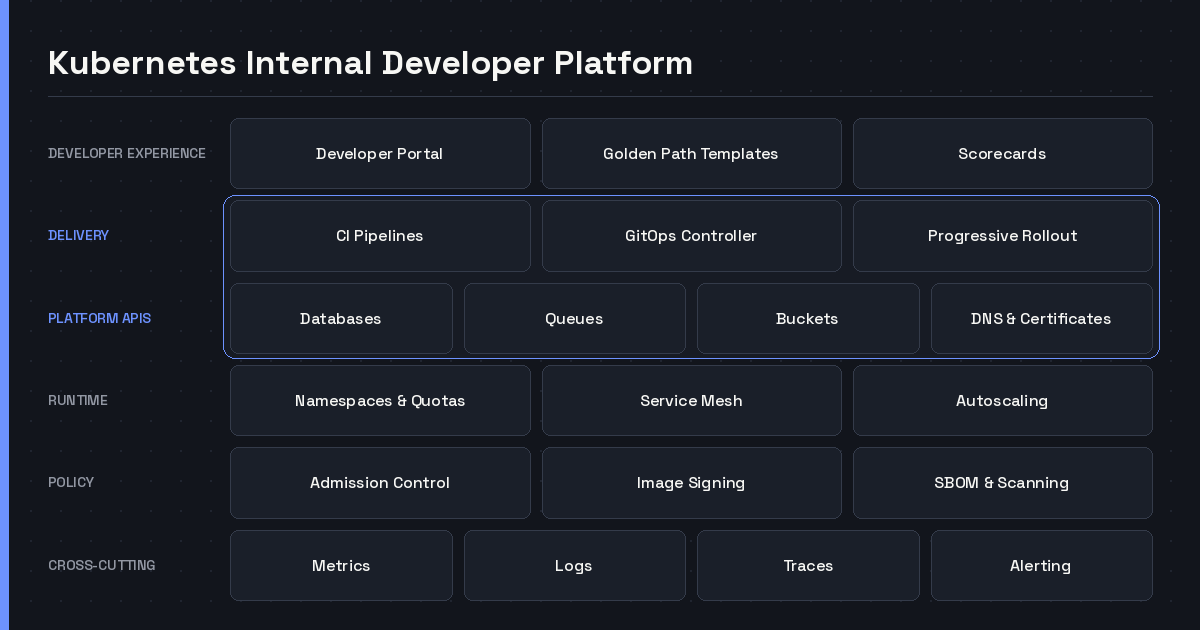
How it fits together
Developer portal
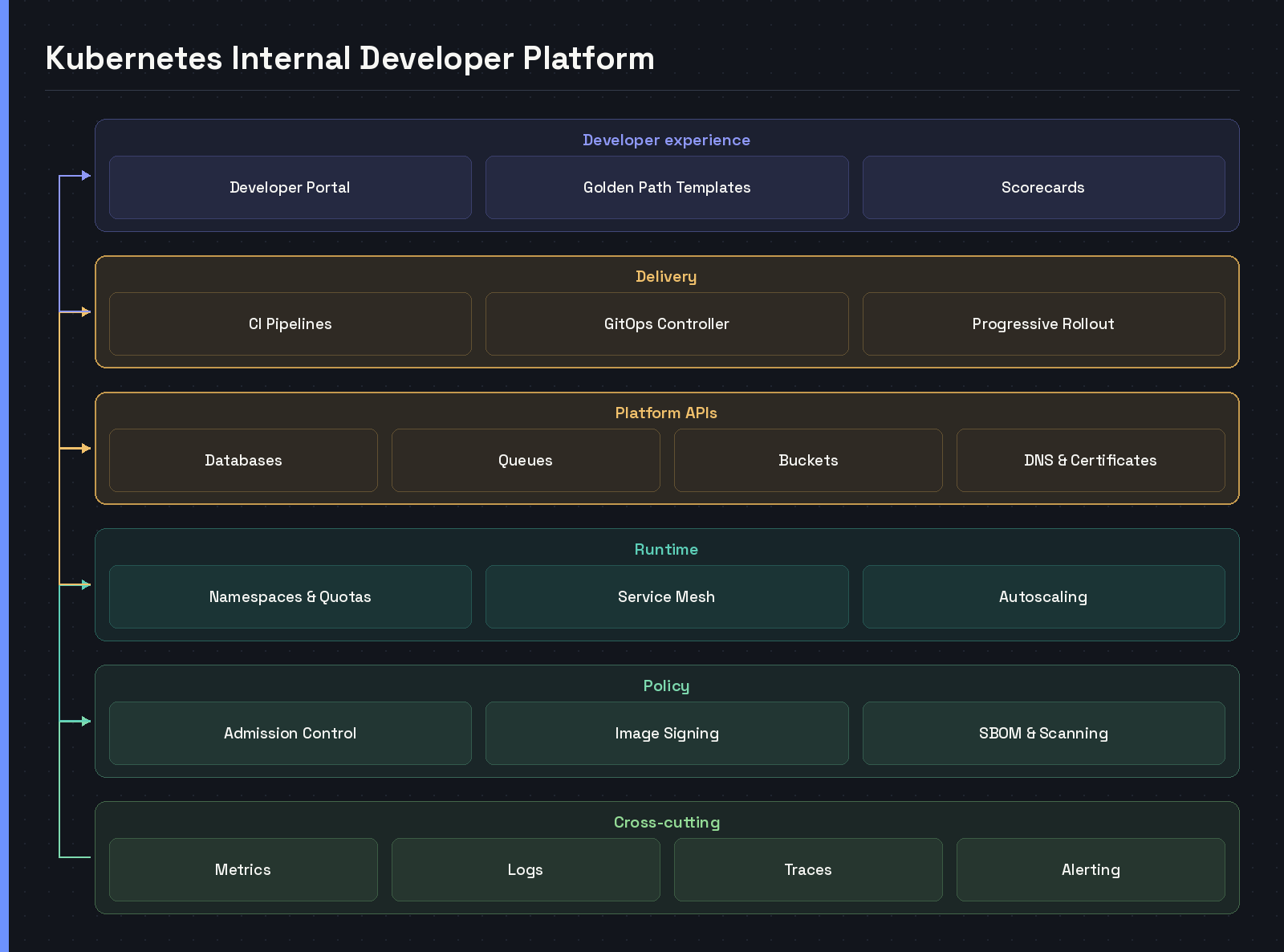
The front door: service catalogue, ownership, scorecards and templates. A new service is scaffolded from a template rather than copied from a neighbour.
Golden paths
Opinionated templates covering repository layout, CI, Dockerfile, Helm chart, alerts and dashboards — the supported route, not the only permitted one.
GitOps delivery
Git is the desired state and a controller reconciles the cluster to it. Deploys are pull requests, rollbacks are reverts, and drift is detected rather than discovered.
Platform APIs
Databases, queues, buckets and DNS requested declaratively and provisioned by the platform, so a team does not need cloud console access to ship.
Cluster runtime
Multi-tenant namespaces with quotas, network policy, a service mesh for mTLS and traffic shifting, and autoscaling at both pod and node level.
Policy and supply chain
Admission policy for what may run, image signing and SBOM generation in CI, and scanning that gates promotion rather than merely reporting.
Unified observability
Metrics, logs and traces collected through one agent and correlated, with dashboards and alerts shipped by the template so a new service is observable on day one.
Typically built with
- Kubernetes
- Argo CD
- Backstage
- Terraform
- Prometheus
- OpenTelemetry