Top 10 Platform Engineering Jobs & Skills
Awareness of emerging skills and the current job market in any field helps you remain relevant and upskilled for future opportunities. That’s why reading about the job postings and skills required for platform engineering got me interested in publishing this blog post, based on the analysis work by PlatformEngineering.com.
As tiny teams are supported by robust platform engineering teams, they can focus on high-value work by providing standardized, automated workflows and self-service AI tools and capabilities. (Source: Gartner)
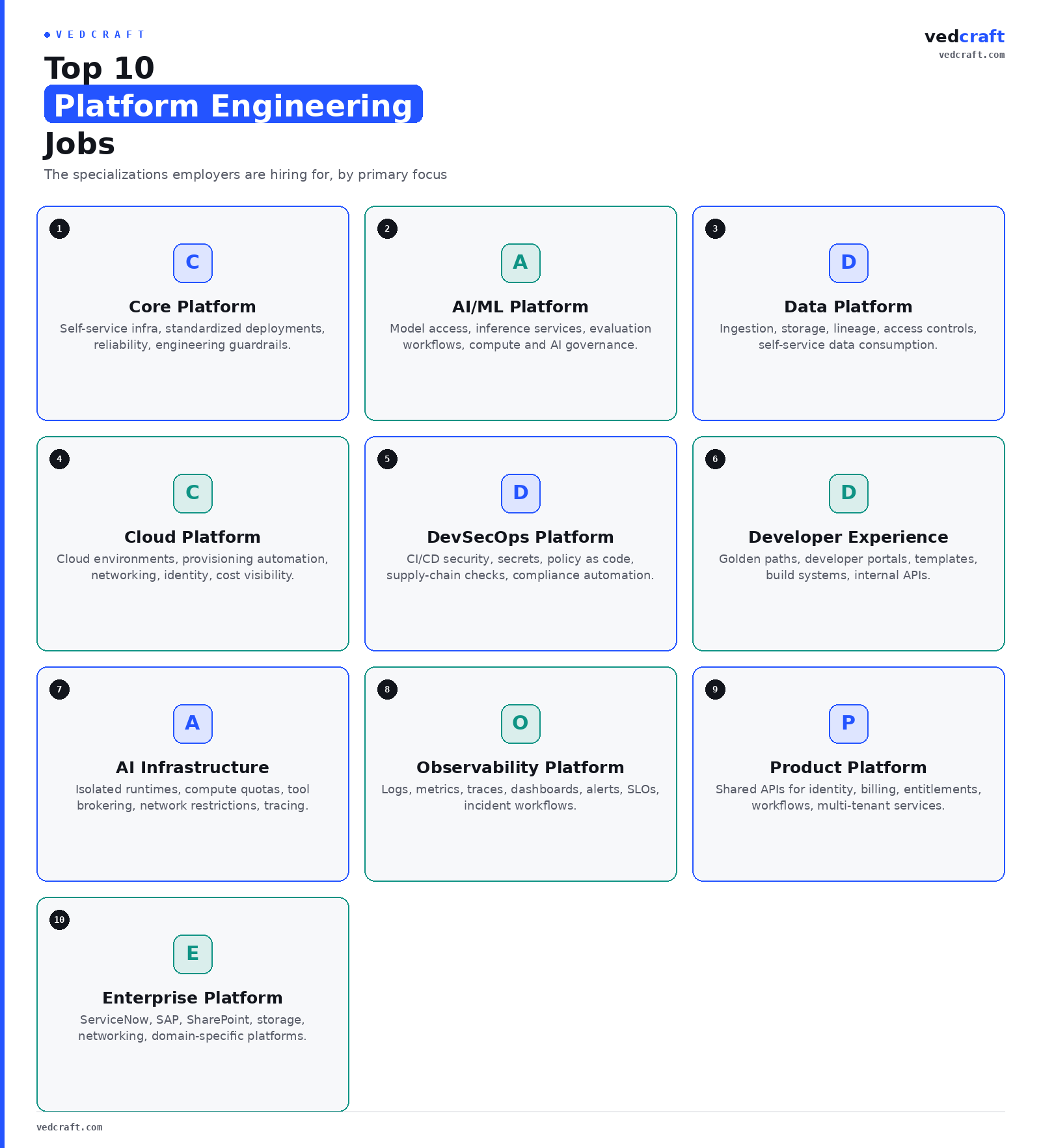
When reviewing two months of platform engineering job postings — tracked and summarized by platformengineering.com — you can observe the top ten specializations and the associated skill sets below.
The Ten Platform Engineering Job Archetypes
-
Core Platform Engineer — focused on developer productivity through self-service capabilities: expertise in tools such as Backstage, Cortex, or LeanIX for the developer portal; CI/CD with Harness, GitHub Actions, ArgoCD, or Jenkins; and IaC with Terraform.
-
AI and ML Platform Engineer — the most demanding job profile, given the Agentic AI-related platform engineering skill gap, primarily in automated model training and inference, also known as GenAIOps.
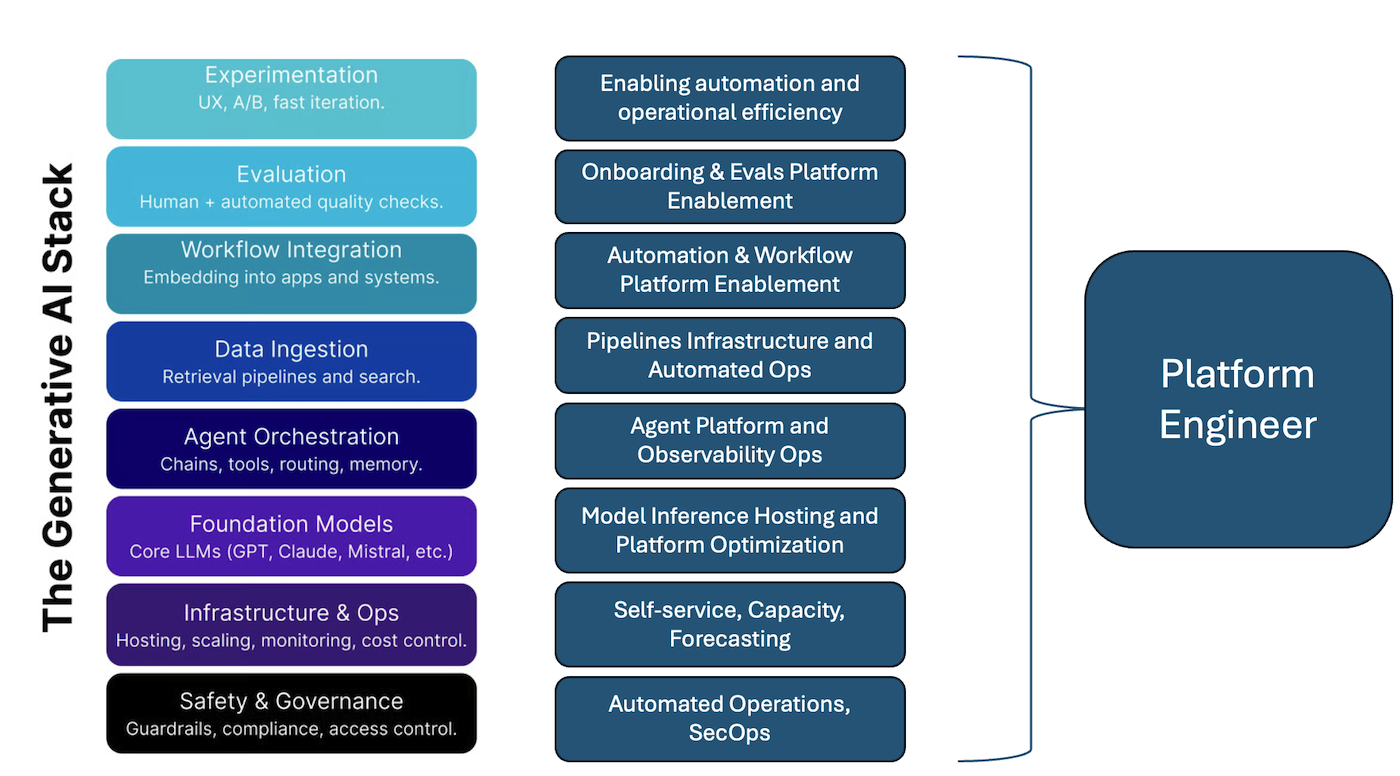
(Source: mapping of the GenAI Stack with platform engineering skills)
-
Data Platform Engineer — with the rising demand for clean data supporting Agentic AI applications, DataOps is in high demand: either platform-focused skills for Databricks, Snowflake, BigQuery, or AWS, or open-source data platform skills for Apache Spark, dbt, Airflow, or Dagster.
-
Cloud Platform Engineer — an evergreen platform engineering skill set, with hyperscaler-centric knowledge of AWS, GCP, or Azure. A platform-specific certification helps here, such as the AWS Certified CloudOps Engineer, AWS Certified DevOps Engineer — Professional, or GCP Professional Cloud DevOps Engineer.
-
DevSecOps Platform Engineer — on top of core DevOps skills, a security-first mindset is one of the most demanding skill sets. Each hyperscaler has a security certification that helps elevate this knowledge, alongside skills such as CI/CD security, secrets and access management, policy as code, software supply chain, and compliance evidence. Experience with a threat modeling framework such as STRIDE (Spoofing, Tampering, Repudiation, Information disclosure, Denial of service, Elevation of privilege) is a huge advantage.
-
Developer Experience Engineer — a unique and emerging platform engineering role working in close collaboration with developers, to build developer workflows and internal engineering products. Key deliverables include golden paths, developer portals, project templates, build systems, internal APIs, and documentation.
The Platform Engineering Organization has published a reference architecture for Internal Developer Platform, which is a great starting point as a reference:
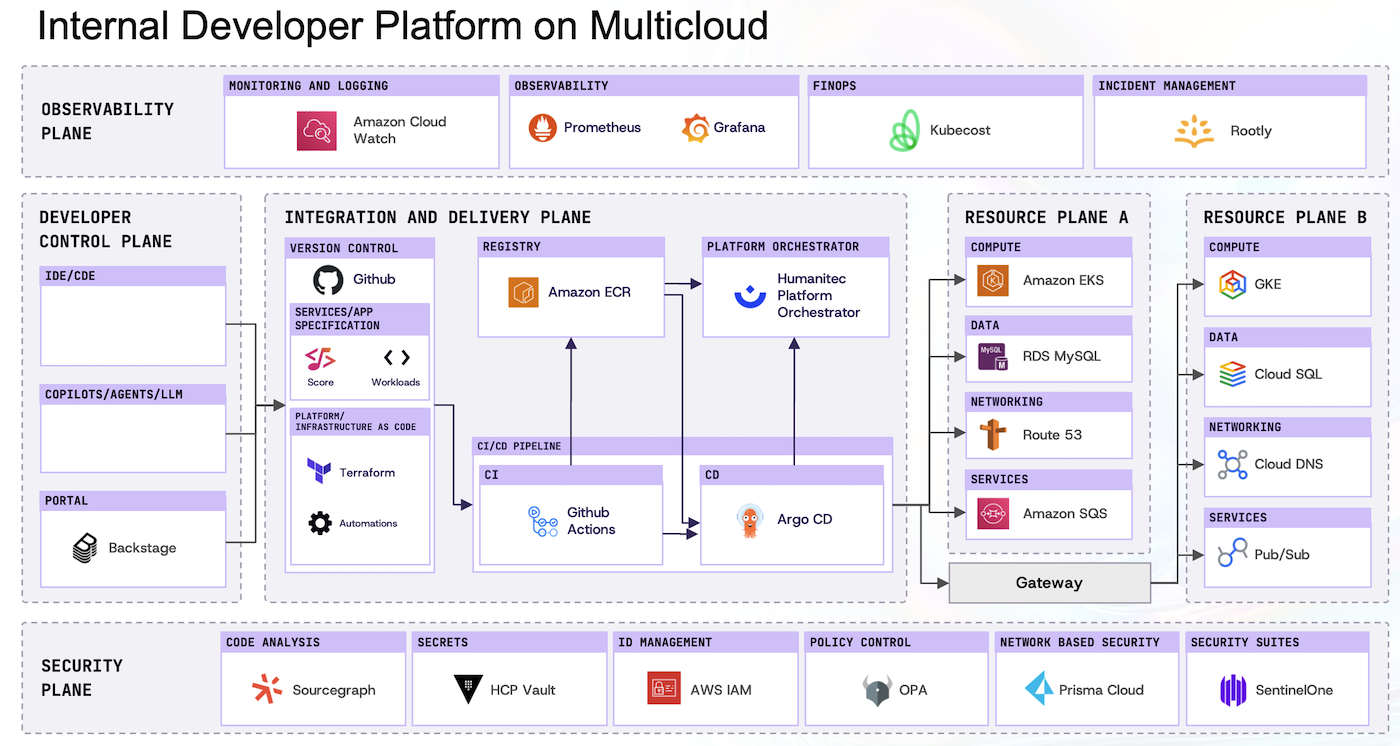 https://platformengineering.org/
-
AI Infrastructure Engineer — a specialized platform engineer with DevOps and AI/ML hosting/inference knowledge, focused on automating model development, training, evaluation, and inference. LLM inference engines have a wide variety of self-hosted open-weights models with inference servers such as vLLM, SGLang, TensorRT, Llama.cpp, or NVIDIA Triton — experience optimizing these runtimes is valuable in the current market. See this learning path from DevOps Engineer to LLMOps/AIOps Platform Engineer.
-
Observability Platform Engineer — focused on telemetry and an end-to-end observability stack, with deep insight into a platform such as Dynatrace or Datadog, plus experience with AI and agent observability solutions such as LangSmith, MLflow, Braintrust, or Langfuse.
-
Product Platform Engineer — focused on shared APIs for identity, billing, entitlements, integrations, auditability, and multi-tenant services.
-
Specialized Enterprise Platform Engineer — focused on automation and governance of ServiceNow, SAP, SharePoint, storage, networking, and industry-specific systems.
The categories overlap. A mature platform team may own cloud provisioning, delivery workflows, observability, security controls, and developer experience as one product. Larger organizations often split those responsibilities into specialist teams. platformengineering.com
Common Capabilities Across Platform Engineering Roles
What are the seven key responsibilities every platform engineering role shares?
-
Build reusable platform products. Infrastructure APIs, deployment templates, service catalogs, CLIs, portals, reference architectures, and well-documented golden paths — the goal is enablement, reducing repetitive implementation work so product teams focus on customer-facing capability.
-
Provide self-service with guardrails. Teams need to provision environments, deploy services, access data, integrate models, and create operational resources without a central operations queue. The platform should make the supported choice the easy choice — approved modules, identity controls, cost limits, security policy, standard deployment patterns.
-
Improve reliability and operational readiness. Capacity planning, fault tolerance, incident response, backups, recovery procedures, SLOs, and production-readiness standards. A good platform reduces operational burden without hiding failure modes — it exposes service health and keeps ownership clear.
-
Standardize software delivery. CI/CD, source control integrations, artifact management, automated testing, release workflows, environment promotion, rollback. The value is reduced lead time and deployment risk; the challenge is flexibility without every team inventing an incompatible process.
-
Embed security, compliance, and governance. Identity and access management, secrets management, vulnerability controls, software supply chain checks, audit logging, policy as code, compliance reporting — built into normal developer workflows rather than bolted on as manual review. This matters most in regulated environments, where governance requiring repeated exceptions does not scale.
-
Create operational visibility. Telemetry standards, dashboards, alerting, SLOs, tracing, incident workflows, cost allocation. In AI-enabled systems, this extends to model selection, token usage, retrieval quality, tool execution, latency, and evaluation results.
-
Manage adoption and developer experience. A technically sound platform still fails if developers avoid it. Useful adoption metrics include time to first deployment, build duration, deployment frequency, change failure rate, mean time to recovery, golden-path adoption, platform cost per workload, and developer satisfaction.
Skills that matter — and why they’re T-shaped
The strongest candidates combine breadth across systems with depth in one specialization — the same T-shaped skills model that shapes the Developer to Architect learning path and the FDE T-shaped career guide: a horizontal bar of platform breadth, and a vertical bar of depth in the specialization a given role actually hires for.
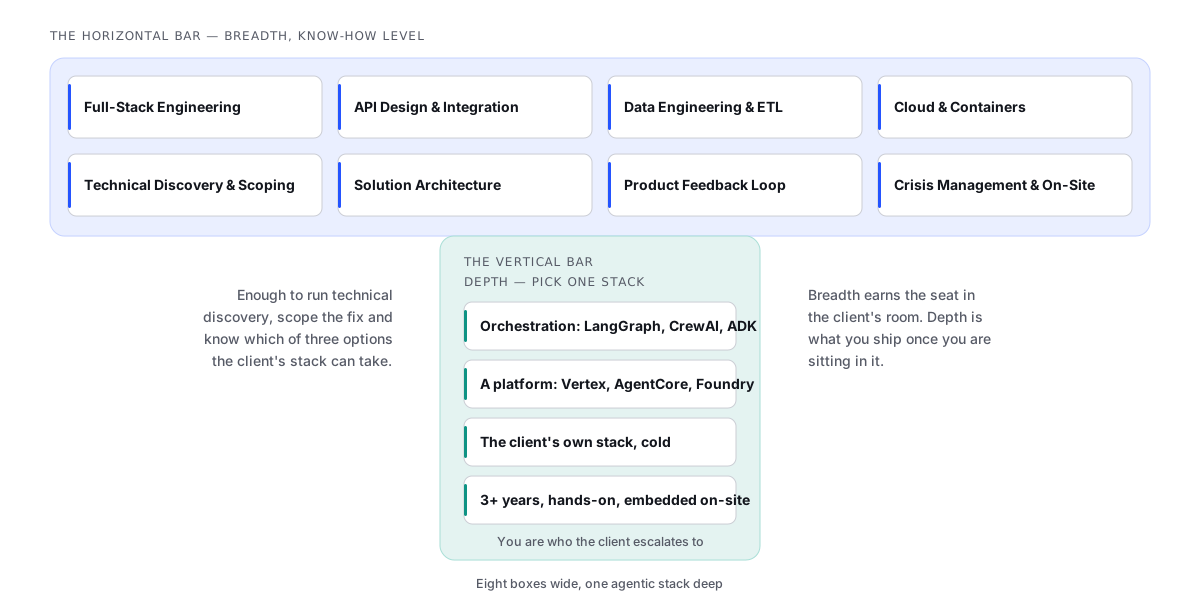
The same shape applies to platform engineering — swap the vertical stem for whichever specialization the role targets:
- Breadth (the top bar): cloud and distributed systems (compute, storage, networking, containers, orchestration, resilience), infrastructure automation (IaC, provisioning, configuration, policy), delivery engineering (CI/CD, build systems, test automation, release engineering), security engineering (identity, secrets, supply chain, auditability), and product thinking (developer research, API design, adoption measurement, documentation).
- Depth (the vertical stem): one specialization taken deep — AI/ML infrastructure, data platforms, cloud service infrastructure, DevSecOps, or developer experience. platformengineering.com
Which stem to grow depends on organizational context. AI and data platform roles fit organizations building intelligent products or managing large volumes of governed data. Cloud and reliability roles suit businesses where scale, availability, and cost are the dominant constraints. DevSecOps platform roles matter most where security and compliance requirements shape the delivery model.
Key Questions
Q1) What is platform engineering?
Platform engineering is the discipline of building internal, reusable infrastructure and tooling products — with guardrails baked in — so product teams can deliver software safely with less friction.
Q2) Is platform engineering the same as DevOps or SRE?
No. DevOps and SRE describe practices and responsibilities for operating and running reliable systems; platform engineering is the job of building the self-service product — the internal developer platform — that makes those practices possible at scale, often for engineers in DevSecOps and SRE roles as end users of that platform.
Q3) Which platform engineering specialization should I learn first?
Start with core platform engineering — infrastructure automation, CI/CD, and observability — as the breadth bar. Then pick one vertical stem based on where your organization has the most pressure: AI/ML platform work if you’re supporting GenAI products, DevSecOps if compliance is the constraint, or developer experience if adoption of existing tooling is the problem.
A practical perspective
Platform engineering is a leverage function. The platform team takes difficult, repeated, cross-cutting work and turns it into a supported capability that many teams can use confidently. The enduring responsibility is the same across all ten roles above: make it easier for developers to build, ship, operate, and govern software at scale.
To summarize: while these platform engineering roles are in demand, a culmination of knowledge as a T-shaped technologist helps you blend your experience into an emerging field — such as Agentic AI, SecurityOps, or GenAIOps — giving you a differentiated profile for enterprises.
Source: Ten Great Platform Engineering Job Opportunities, platformengineering.com
References
- Ten Great Platform Engineering Job Opportunities
- Gartner Predicts 60% of Organizations Will Adopt Smaller Software Engineering Teams by 2029
- MLOps Maturity Model by Azure Architecture Center
- The GenAIOps Framework
- Platform Engineering Internal Developer Platform (Reference Architecture)
- DataOps Architecture Overview by IBM