Claudeforce: Salesforce's Winning GTM Strategy
On 26 August 2026, Salesforce and Anthropic announced Claudeforce, an expanded partnership that runs in two directions at once. Salesforce moves into Claude as a plugin with 37 prebuilt sales skills. Claude moves into Salesforce as a reasoning model. The integration is interesting. The go to market (GTM) strategy underneath it is the part worth studying.
What Claudeforce actually is
Claudeforce is the commercial and technical partnership that makes Salesforce data, workflows, business logic and governance available to Claude, while making Claude the reasoning engine inside Salesforce’s own agent products. It ships as two distinct things:
- Salesforce in Claude, a plugin carrying 37 prebuilt sales skills, available to a select group of pilot customers with an open beta expected in September 2026 and further skills later in the year.
- Claude in Agentforce, where Claude serves as a reasoning model for the Atlas Reasoning Engine, powers Agentforce Vibes and Agentforce Coworker by default, and is selectable in Agent Builder.
Salesforce also disclosed that it plans to spend roughly $300 million on Anthropic tokens in 2026, on top of an existing $300 million equity stake. That is a supply commitment, not a pilot budget, and it tells you how central the partnership is to the roadmap.
Why the two way design is the strategy
Most vendor AI announcements pick one direction. They either bolt a model onto the product, or they publish a connector so an assistant can read the product’s data. Claudeforce does both, and the two directions defend different things.
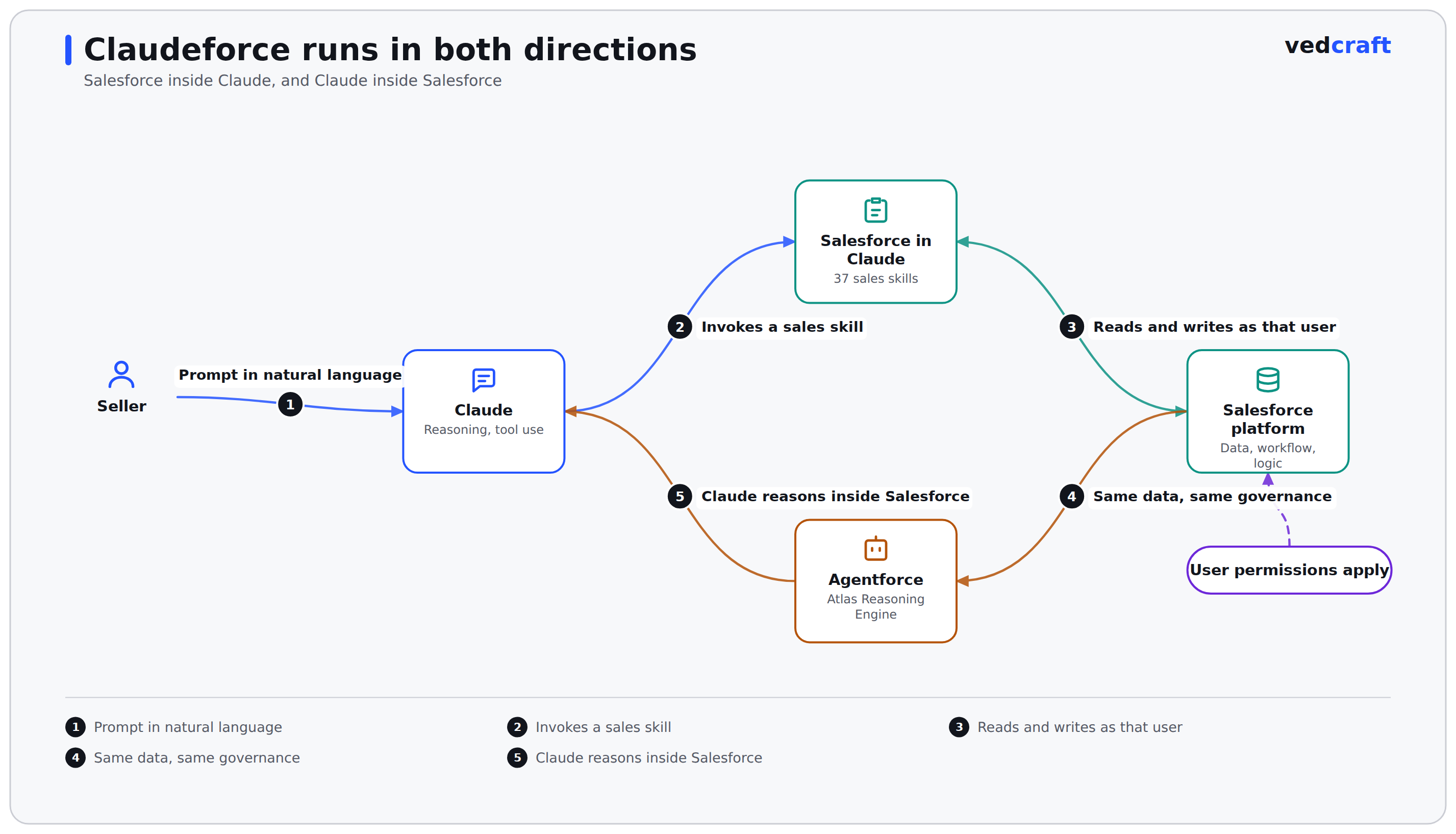
Direction one protects distribution. If sellers are going to spend their day in a general purpose assistant, Salesforce would rather be the CRM inside that assistant than a browser tab the seller stops opening. Direction two protects the product. If reasoning quality is what differentiates an agent platform, Salesforce would rather rent frontier reasoning than fund the multi year effort to match it.
Neither move is defensive on its own. Together they mean Salesforce wins whether the work happens in Claude or in Salesforce, which is the useful way to read the announcement.
Direction one: Salesforce inside Claude
The plugin gives sellers 37 skills covering meeting preparation, deal health review, pipeline review, drafting emails and updating CRM records. Salesforce and Anthropic report building these against Claude’s reasoning, agentic tool use and generative user interface rather than wrapping generic prompts around a REST API.
Three design choices matter more than the skill count:
- Skills, not raw tools. A skill packages the retrieval, the business logic and the output shape for one job. A seller asking for a pipeline review gets a pipeline review, not a set of tool calls they have to assemble. This is the same packaging argument behind context engineering: what you put in front of the model determines the quality of what comes back.
- Identity flows through. Reporting on the integration describes per user authentication through an External Client App, with each call executing as that person. Object permissions, field level security and sharing rules apply exactly as they do in the Salesforce interface. If you cannot see a record in Salesforce, the plugin cannot see it for you.
- Writes, not just reads. Keeping the pipeline updated from inside Claude is what turns the integration from a reporting convenience into a workflow. It is also where governance stops being a checkbox and starts being load bearing.
That third point is the one I would test hardest in a pilot. A read only assistant that hallucinates costs you a bad answer. An assistant with write access that misreads intent costs you a corrupted opportunity record and a forecast that nobody trusts.
Direction two: Claude inside Salesforce
The second direction is quieter and, commercially, probably the larger one. Salesforce reported Agentforce annualised revenue above $1.5 billion, up 240% year over year, alongside a quarter that sent the shares up more than 12%. Reasoning quality is the input to that number.
Buying it rather than building it has a clear logic. Frontier model gaps close in months, and a CRM vendor competing on pretraining is competing on someone else’s cost curve. Renting reasoning lets Salesforce spend its engineering on the harness: the data model, the permissions, the workflow, the audit trail. That harness is the part a model vendor cannot easily replicate, and it is where Salesforce’s twenty five years of enterprise trust actually live.
The trade off is real, and Salesforce has accepted it deliberately. A default model relationship this deep is a step away from the model agnostic posture most enterprise software has claimed for the past three years. Agent Builder still allows model selection, so the door is open, but the defaults are where the volume goes.
Why this reads as a winning go to market move
Marc Benioff spent the earnings call pushing back on the “SaaSpocalypse” thesis, the argument that capable AI assistants make subscription software unnecessary. Claudeforce is the structural answer to that argument rather than the rhetorical one.
| Threat to the SaaS model | Claudeforce response |
|---|---|
| Users work in an assistant, not the vendor’s application | Ship the application into the assistant as a governed plugin |
| Model quality becomes the product differentiator | Rent frontier reasoning, compete on data and governance instead |
| Agents bypass permissions and audit trails | Execute every call as the authenticated user, under existing sharing rules |
| The system of record commoditises into a database | Make the business logic and workflow, not the storage, the thing being called |
Read as a whole, the position is that the interface is negotiable and the governed system of record is not. That is a more durable claim than defending the user interface, and it is a fair one: the hard part of enterprise AI has never been generating text, it has been knowing which rows a given person is allowed to act on.
Whether it holds depends on execution. An open beta in September with a select pilot group is early, and 37 skills is a starting inventory rather than a finished product.
What this means for enterprise architecture teams
If you run Salesforce, this is worth a deliberate assessment rather than either a rush or a shrug. A few implications I would weigh:
- Treat the plugin as a new access path to production data. It inherits your permission model, which is good, but it also inherits your permission model’s gaps. Sharing rules written for a human clicking through a list behave differently when an agent can traverse thousands of records in a single request. Audit what a broad profile can actually reach before you enable writes.
- Decide where the agent boundary sits. Sales work in Claude and service work in Agentforce is a defensible split. Both surfaces doing overlapping work with different context is how you get two systems disagreeing about the same deal.
- Keep model portability a live requirement. The same argument I made about unified model access becoming the real moat applies here in reverse. A deep default relationship is convenient until pricing or capability changes; confirm what switching a model in Agent Builder actually costs you in rebuilt prompts and revalidated skills.
- Ask what happens to your context. Skills that pull across CRM, Slack and email assemble a richer picture of your commercial position than any single system holds. That is the value, and it is also the governance question. Get the data handling terms in writing.
- Do not skip the adoption work. The failure mode for this class of tooling is not technical. It is a seller who tries a pipeline review, gets an answer that is subtly wrong about a deal they know well, and never opens it again.
For teams still deciding whether this is the right moment to commit, the framework in when to adopt an emerging technology applies cleanly: pilot where the cost of a wrong answer is low, and wait for the governance surface to settle before wiring it into forecasting.
The risks worth weighing
I would not present this as settled. Three things could reasonably go the other way:
- Concentration risk. A $300 million token commitment and a default model relationship give Anthropic meaningful leverage over Salesforce’s cost structure. That is a normal supplier risk, but it is larger than a typical vendor dependency.
- The disintermediation argument is not dead. Salesforce has answered it by moving into the assistant, but a plugin is a weaker commercial position than an application. Renewal conversations look different when the daily habit lives somewhere else.
- Governance at agent speed is unproven. Permission models designed for human throughput have not been stress tested by agents making hundreds of calls per task. This is where I would expect the first genuine incidents.
Key questions
Q1) What is Claudeforce?
Claudeforce is a partnership between Salesforce and Anthropic, announced on 26 August 2026, that integrates the two products in both directions. Salesforce runs inside Claude as a plugin with 37 prebuilt sales skills, and Claude runs inside Salesforce as a reasoning model for the Atlas Reasoning Engine and Agentforce.
Q2) How does Claudeforce handle security and permissions?
Every call executes as the authenticated Salesforce user rather than through a shared service account, so object permissions, field level security and sharing rules apply exactly as they do in the Salesforce interface. A record you cannot open in Salesforce is a record the plugin cannot read on your behalf.
Q3) Why did Salesforce choose one model vendor instead of staying model agnostic?
Because reasoning quality is the input to Agentforce revenue, and matching frontier model capability internally would mean competing on a cost curve Salesforce does not control. Renting reasoning frees its engineering to compete on the data model, workflow and governance layer, which is harder for a model vendor to replicate. Agent Builder still allows model selection, so the choice is about defaults rather than exclusivity.
Q4) What should an enterprise architecture team do about Claudeforce now?
Audit what your existing sharing rules expose when an agent traverses records at scale, decide which surface owns which workflow before both are enabled, and confirm the cost of switching models in Agent Builder before the default relationship becomes structural. Pilot on workflows where a wrong answer is cheap to correct.
Why it matters
The most transferable lesson here is not about CRM. It is that the defensible layer in enterprise AI is turning out to be the governed harness around a model rather than the model or the interface. Salesforce has bet that it can give up the interface and rent the intelligence while keeping the part that is genuinely hard to copy. If that bet is right, the same play is available to any vendor whose real asset is a permission model and a workflow rather than a screen.
I would be interested to hear how other architecture teams are approaching the governance question specifically, and whether anyone has stress tested their sharing rules against agent scale traversal yet.
Disclaimer:
Product details, availability dates and financial figures in this post are drawn from the Salesforce and Anthropic announcement and contemporaneous media reporting as of publication, and may change as the product moves from pilot to general availability. All data and information provided on this blog are for informational purposes only. All the image sources used are for reference only. The author makes no representations as to the accuracy, completeness, correctness, suitability, or validity of any information on this blog and will not be liable for any errors, omissions, or delays in this information or any losses, injuries, or damages arising from its display or use. This is a personal view and the opinions expressed here represent my own and not those of my employer or any other organization.