Stripe-OpenRouter Deal: Unified Model Access Is a Moat
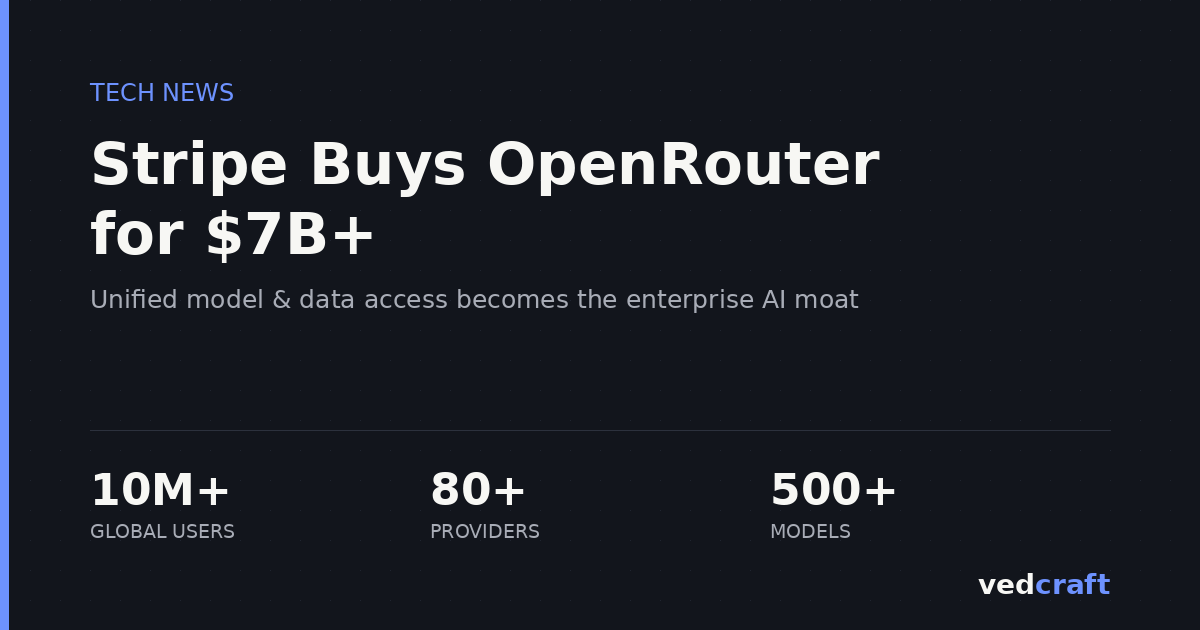
Stripe has agreed to acquire OpenRouter, the AI model gateway startup. Official terms weren’t disclosed, but Bloomberg and TechCrunch independently report the price at more than $7 billion — roughly 5.4x its $1.3 billion valuation three months earlier. Paying that premium for a routing layer, not a model, is the signal worth reading: the moat is shifting from which model you have to how you access, pay for, and govern all of them.
What OpenRouter actually is
Founded in 2023, OpenRouter built the first LLM marketplace — a unified gateway to the AI model market, at scale:
- 10M+ global users
- 80+ providers
- 500+ models
Its platform spans four pieces:
- Unified API (AI Gateway) — one standardized endpoint across 500+ models and 80+ providers, with smart routing, automatic fallbacks, and price optimization.
- Model marketplace & benchmarks — real-time rankings, performance metrics, and cost-comparison tools for evaluating LLMs.
- OpenRouter Chat — a web-based app for testing and interacting with models directly.
- Enterprise & developer workspace — analytics, API key management, cost controls, and team management for production deployments.
That scale, more than the model roster, is what a payments company can price. Stripe CEO Patrick Collison put the rationale in metering terms:
“Tokens are the central currency for companies building with AI, and it’s clear that the real-world economic potential will depend on making good use of scarce compute resources.”
That’s a billing and infrastructure framing, not a model-selection one.
Why Stripe is the acquirer, not an AI lab
It would be easy to read this as an AI story. It’s more accurately a payments-infrastructure story with an AI-shaped market underneath it. Three reasons this acquisition made sense for Stripe specifically, and not for a model vendor:
- Token spend behaves like transaction volume. Every request routed through OpenRouter is a metered, billable event across dozens of providers and currencies. That is Stripe’s core competency — usage-based billing, multi-party payouts, and reconciliation at scale — applied to a new unit of consumption.
- A neutral gateway needs a neutral owner. OpenRouter’s value to developers depends on it not favoring any one model provider. An acquisition by OpenAI, Anthropic, or a hyperscaler would have compromised that neutrality immediately; a payments company has no model to protect.
- Distribution compounds faster than any single model’s lead. Model quality gaps between frontier labs now close in months. A gateway that already sits in front of 10 million+ users’ AI traffic is a distribution asset that survives whichever model wins any given quarter.
The moat is access and data, not any one model
This is the part worth internalizing for architecture and platform decisions, independent of how the deal itself is financed. Three capabilities compound into a durable position, and none of them require owning a foundation model:
- Unified infrastructure. One integration, one API key, one billing relationship in front of hundreds of models. Every provider a team adds directly is another SDK, another auth flow, another rate-limit policy to operate — cost that a gateway absorbs once on behalf of everyone routing through it.
- Marketplace routing power. Dynamic routing to the cheapest or best-performing model per request, per task, is what protects an enterprise from vendor lock-in. That protection is only credible coming from a party with no model of its own to favor — which is exactly the neutrality point above.
- A macro view of AI spend. A gateway processing that much token volume gets a live, cross-industry read on which models enterprises are actually running at scale, at what cost, for what workloads — a data asset no single model provider can see, because it only sees its own traffic.
Put together, these three are why “unified model and data access” reads as a moat and “best model” does not: the model layer is being commoditized by frontier-lab competition in real time, while the access-and-data layer accumulates advantage the longer it operates.
What this means for architecture and platform teams
If your organization already routes LLM traffic through an API gateway pattern — whether OpenRouter, a hyperscaler’s model garden, or an internal proxy — this deal is a data point in favor of that architecture, not a reason to second-guess it. A few implications worth weighing:
| Consideration | Direct provider integration | Gateway/marketplace layer |
|---|---|---|
| Vendor lock-in | High — each provider is a separate contract and SDK | Low — routing logic is centralized, providers are swappable |
| Cost optimization | Manual, per-provider negotiation | Dynamic, request-level routing to cheapest/best model |
| Operational overhead | Grows linearly with each added provider | Absorbed once by the gateway |
| Data visibility for the vendor | Provider sees only its own traffic | Gateway sees cross-provider usage — leverage for the gateway, a governance question for you |
| Neutrality risk | None — you own the relationship | Depends on the gateway’s ownership; Stripe’s payments background is neutral on models, but every acquisition resets that question |
That last row is the one to watch closely if OpenRouter is already in your stack. A neutral gateway stays neutral only as long as its incentives stay neutral — worth confirming in writing (routing SLAs, no preferential placement, data-usage terms) rather than assuming continuity through an ownership change.
Why it matters
For an enterprise AI platform strategy, the practical takeaway is to architect for model portability now, independent of any single vendor’s roadmap: a gateway abstraction in front of model calls, usage metering built at the request level rather than bolted on later, and contractual clarity on how your token-usage data can be used by whoever operates that layer. The model you pick this quarter will very likely not be the model you’re running in twelve months. The access layer you build around it is what determines how expensive that change turns out to be.
Key questions
Q1) Why did a payments company acquire an AI model gateway instead of a foundation model lab?
Because the durable value in the deal is metered, multi-provider token usage — a billing and infrastructure problem Stripe already knows how to operate at scale — not any single model’s capability, which is being commoditized by frontier-lab competition.
Q2) Does using an AI gateway like OpenRouter reduce vendor lock-in?
Yes, structurally: a gateway lets you route requests to different models per task without rewriting integrations, so switching or mixing providers is a routing-config change rather than a re-platforming project. That protection depends on the gateway staying neutral among providers, which is worth confirming contractually, especially after an ownership change.
Q3) What should platform teams do in response to this acquisition?
Treat it as validation of the gateway pattern rather than a reason to change course: keep model access behind an abstraction layer, meter usage at the request level, and revisit data-usage and neutrality terms with any gateway vendor whenever its ownership changes.
I’d be interested to hear how other architecture and platform teams are treating gateway neutrality in their own vendor agreements as this layer of the AI stack keeps consolidating.
Disclaimer:
The $7B+ deal value cited in this post is based on media reporting (Bloomberg, TechCrunch) and has not been officially confirmed by Stripe or OpenRouter as of publication. All data and information provided on this blog are for informational purposes only. All the image sources used are for reference only. The author makes no representations as to the accuracy, completeness, correctness, suitability, or validity of any information on this blog and will not be liable for any errors, omissions, or delays in this information or any losses, injuries, or damages arising from its display or use. This is a personal view and the opinions expressed here represent my own and not those of my employer or any other organization.