Postman Launches AI Stack for Agentic Capabilities

Postman co-founder and CEO Abhinav Asthana has introduced Postman.ai, a new hub for the company’s AI Stack — a set of products built to take AI agents from prototype to production against real enterprise APIs.
The four pieces of the Agent Stack
Postman is positioning the stack as infrastructure for what it calls the agentic era, where agents call APIs at a volume and pace traditional tooling wasn’t designed for:
-
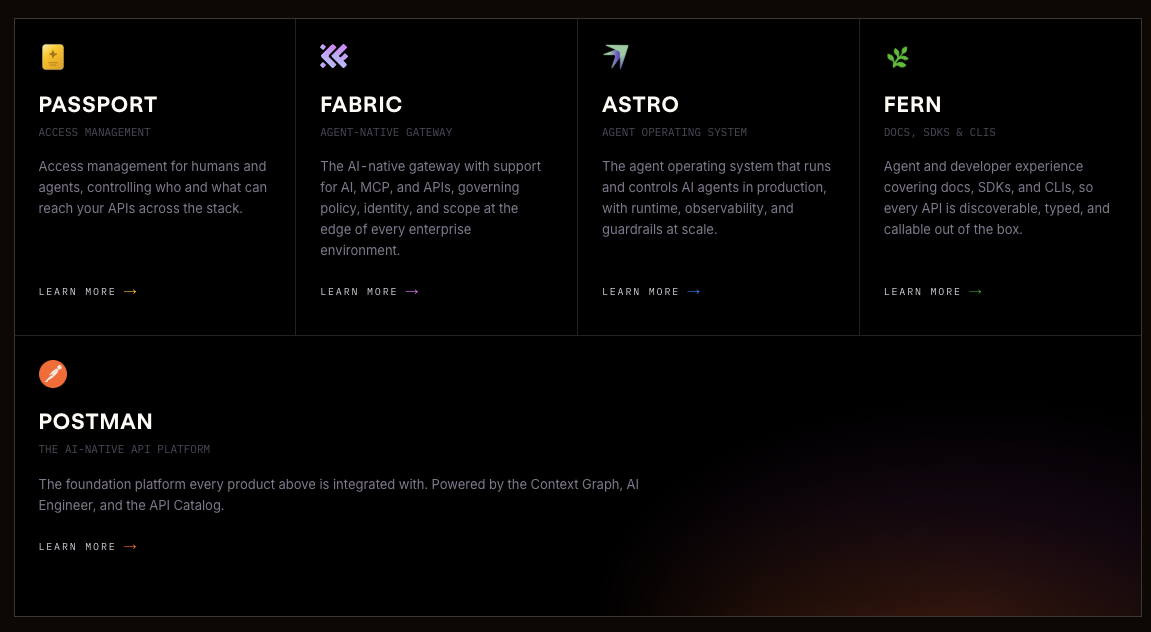
Passport — access management for humans and agents. It hands agents credential references instead of raw API keys, keeping secrets inside the enterprise’s own VPC and letting an agent delegate scoped, time-limited access to sub-agents rather than sharing a long-lived key.
-
Fabric — an AI-native gateway for AI, MCP (Model Context Protocol), and API traffic, governing policy, identity, and scope at the edge of the environment. It integrates with LLM providers including OpenAI, Anthropic, Google Gemini, Azure, AWS Bedrock, Cohere, Mistral, Meta Llama, and DeepSeek, and can expose internal APIs as governed routes from Postman collections, OpenAPI/AsyncAPI specs, or the Private API Network. Using Postman Fabric, you will be able to:
- Have a single plane to manage all MCP servers - public or private
- Expose internal APIs as MCP tools
- Centralize SaaS credentials
- Govern agent traffic and run policies at a consumer, route, or service level
- Deploy on cloud or in a hybrid model
- Astro AI — an agent operating system for discovering, managing, and operating agents in production, packaging them into portable, versioned artifacts with guardrails, observability, and lifecycle control. It layers an Agent Registry, Agent Scorecard, Agent Observability, and Agent Memory over a shared Agent Runtime, with local development tooling underneath so agents built on a developer’s machine carry the same runtime into production. The core part of the solution is to provide:
- An open harness spec: execution graph, tool contracts, guardrail policies, data substrate, observability config, and deployment metadata in a single versioned artifact.
- A packaged agent is portable across runtimes, model-agnostic, and consumable via HTTP or surfaced directly in Slack.
- Fern — agent and developer experience, generating agent-first SDKs, CLIs, and documentation directly from API specs. Postman acquired Fern to bring this piece in-house.
(Source: Postman.ai)
A benchmark to back it up
Alongside the stack, Postman released APIFlow-Bench, a vendor-neutral benchmark for whether an AI agent can carry out a long, stateful enterprise API workflow end to end — not just call an API once, but preserve context, recover from failures, and handle auth, quotas, and error codes without losing the thread. The initial run covered 19 models across 467 tasks and tens of thousands of trials, with a public leaderboard and raw trial transcripts. It’s a useful reality check for anyone evaluating agent frameworks against enterprise APIs, and it doubles as Postman’s argument for why Fabric and Astro AI’s guardrails matter: most failures it surfaces are exactly the state-management and recovery problems those two products are built to catch .
Scoring how AI-ready your own APIs are
Postman also offers a free AI-Ready API Score assessment, built on the premise that an AI-ready API is one an agent can discover, interpret, and operate without a human in the loop. It scores an API against things like complete, machine-readable metadata (request types, parameter schemas, response structures), structured error messages an agent can act on, spec quality enforced through governance and CI, and whether the API is discoverable at all — an API without structured, searchable metadata is effectively invisible to an agent. It’s a quick way for teams to see, before adopting the rest of the stack, where their existing APIs would trip up an agent.
Why it matters
The launch extends the direction Postman set out earlier this year with “The New Postman” — Git-connected workspaces, an API Catalog acting as a management plane, and an updated Private API Network — by adding the access, gateway, and operations layer agents specifically need. For architects and platform teams already standardizing on Postman for API design and testing, the Agent Stack is worth evaluating as a single vendor’s answer to agent identity, governance, and observability, rather than assembling those functions from separate tools. As with any platform bet, the usual questions apply before adopting broadly: how it fits an existing API gateway and IAM footprint, and what it costs to operate at agent-scale traffic.
Disclaimer:
All data and information provided on this blog are for informational purposes only. All the image sources used are for reference only. The author makes no representations as to the accuracy, completeness, correctness, suitability, or validity of any information on this blog and will not be liable for any errors, omissions, or delays in this information or any losses, injuries, or damages arising from its display or use. This is a personal view and the opinions expressed here represent my own and not those of my employer or any other organization.