# Building Blocks for the Open Lakehouse Architecture
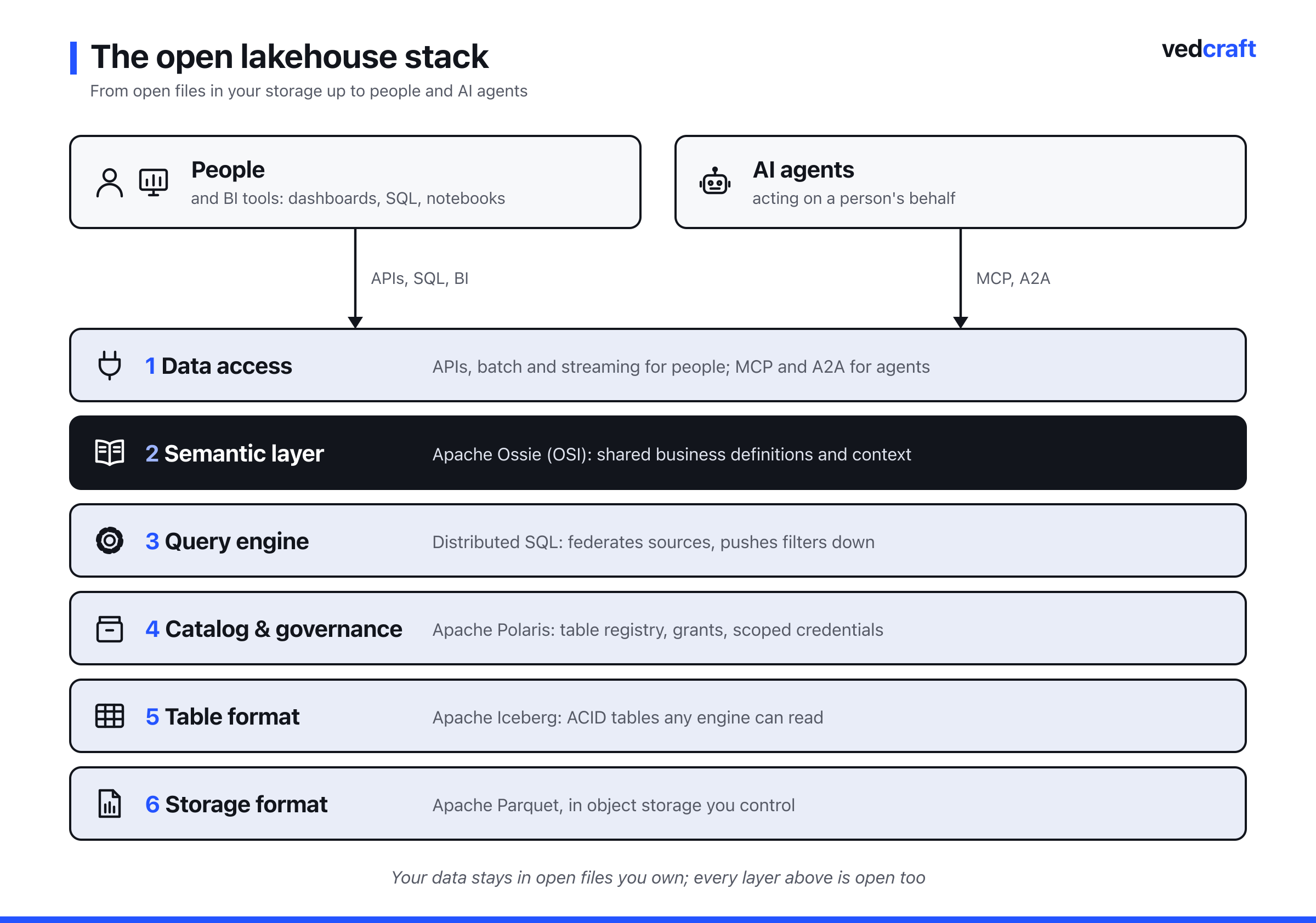
Building a vendor-neutral, open-source data lakehouse gives you a flexible, customizable, scalable, secure and governed data platform. In the agentic era it is a foundational enabler. In simple terms, an open lakehouse architecture has six essential layers, each with open-source standards and solutions available:
- **Data Access Interface**: Traditional interfaces (APIs, batch, streaming) plus an **MCP** interface for agents.
- **Semantic Layer**: Shared business definitions and concepts, usually a virtual semantic layer to avoid data movement, with **Apache Ossie** (earlier Open Semantic Interchange or OSI) emerging as a standard to describe columns in business terms. See [building an open semantic data layer for agentic apps](https://vedcraft.com/tech-trends/data-engineering/building-open-semantic-data-layer-for-agentic-apps/).
- **Query Engine**: Fast SQL-based access across the data lakehouse and other sources.
- **Open Catalog and Governance Layer**: A vendor-neutral, industry-standard catalog such as **Apache Polaris** keeps track of which tables exist and manages access and governance (identity and permissions). Masking and lineage are additional capabilities which need to be added through the query engine and tools such as OpenLineage.
- **Open Table Format**: Vendor-neutral, industry-standard **Apache Iceberg** turns files stored in object storage into user-friendly tables.
- **Open Storage Format**: Vendor-neutral, industry-standard **Apache Parquet** stores the bytes on disk.
## What are the layers of an open lakehouse architecture?
```mermaid
%%{init: {"flowchart": {"nodeSpacing": 16, "rankSpacing": 18, "padding": 8}}}%%
flowchart TD
L1["1. Data Access Interface
APIs · Batch · Streaming · MCP for agents"]
L2["2. Semantic Layer
Apache Ossie (OSI)"]
L3["3. Query Engine
Distributed SQL engines"]
L4["4. Open Catalog & Governance
Apache Polaris"]
L5["5. Open Table Format
Apache Iceberg"]
L6["6. Open Storage Format
Apache Parquet on object storage"]
L1 --> L2 --> L3 --> L4 --> L5 --> L6
```
## Key Questions
### Q1) Why is Apache Parquet the de facto file layer?
Parquet, as an open-source standard, has been adopted by leading vendors, both proprietary and open-source.
It provides the performance benefits of a columnar file format by grouping rows into chunks called row groups and storing each column contiguously. Read more in the [Parquet concepts documentation](https://parquet.apache.org/docs/concepts/).
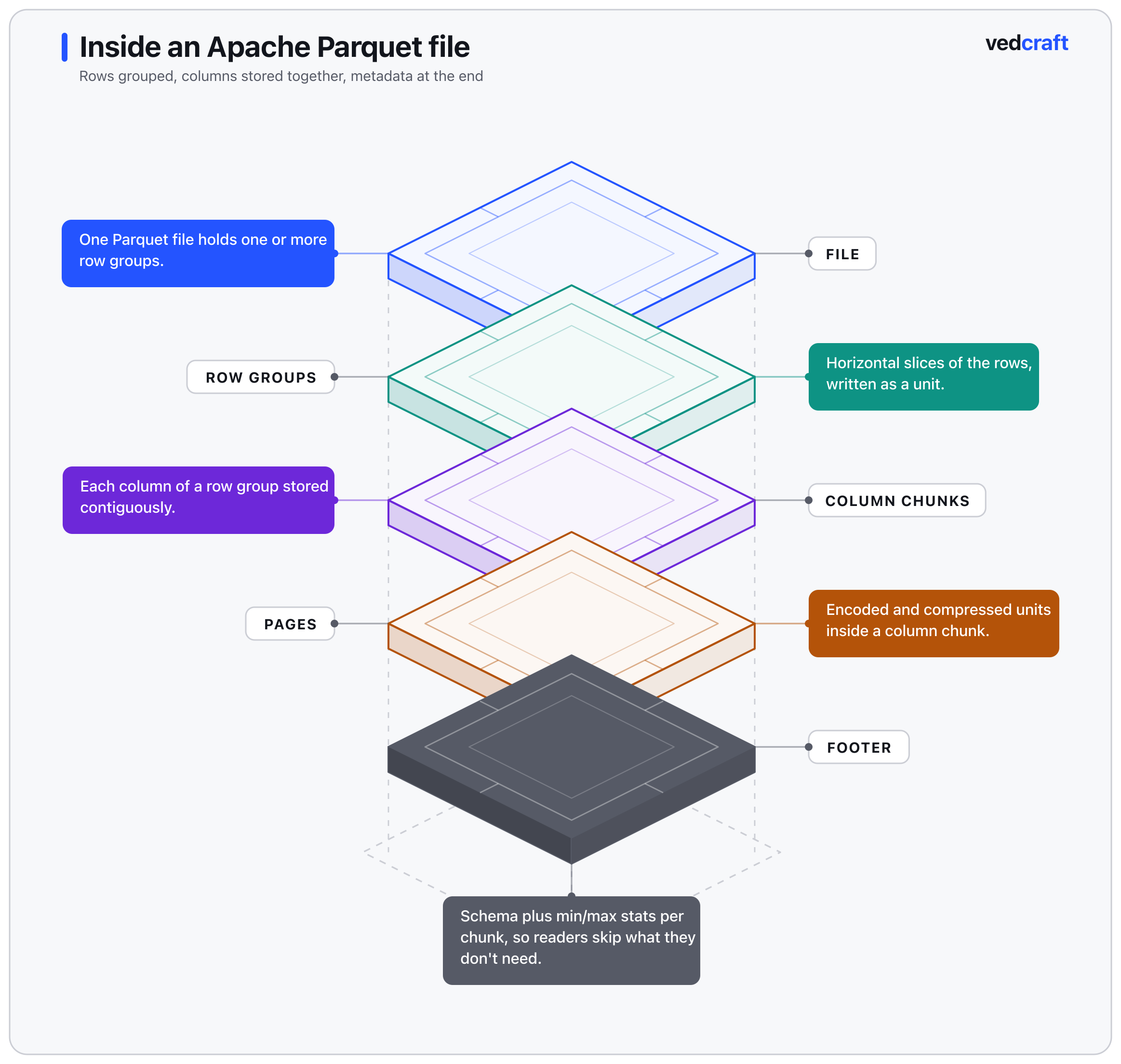
For the byte-level details, see the [Parquet file format specification](https://parquet.apache.org/docs/file-format/).
### Q2) Why do we need Apache Iceberg?
Apache Iceberg has become the common standard for open table formats, bridging the gap between competing formats such as Delta Lake and Apache Hudi, and proprietary formats such as Snowflake's.
It adds database-like capabilities to Parquet datasets stored in a data lakehouse.
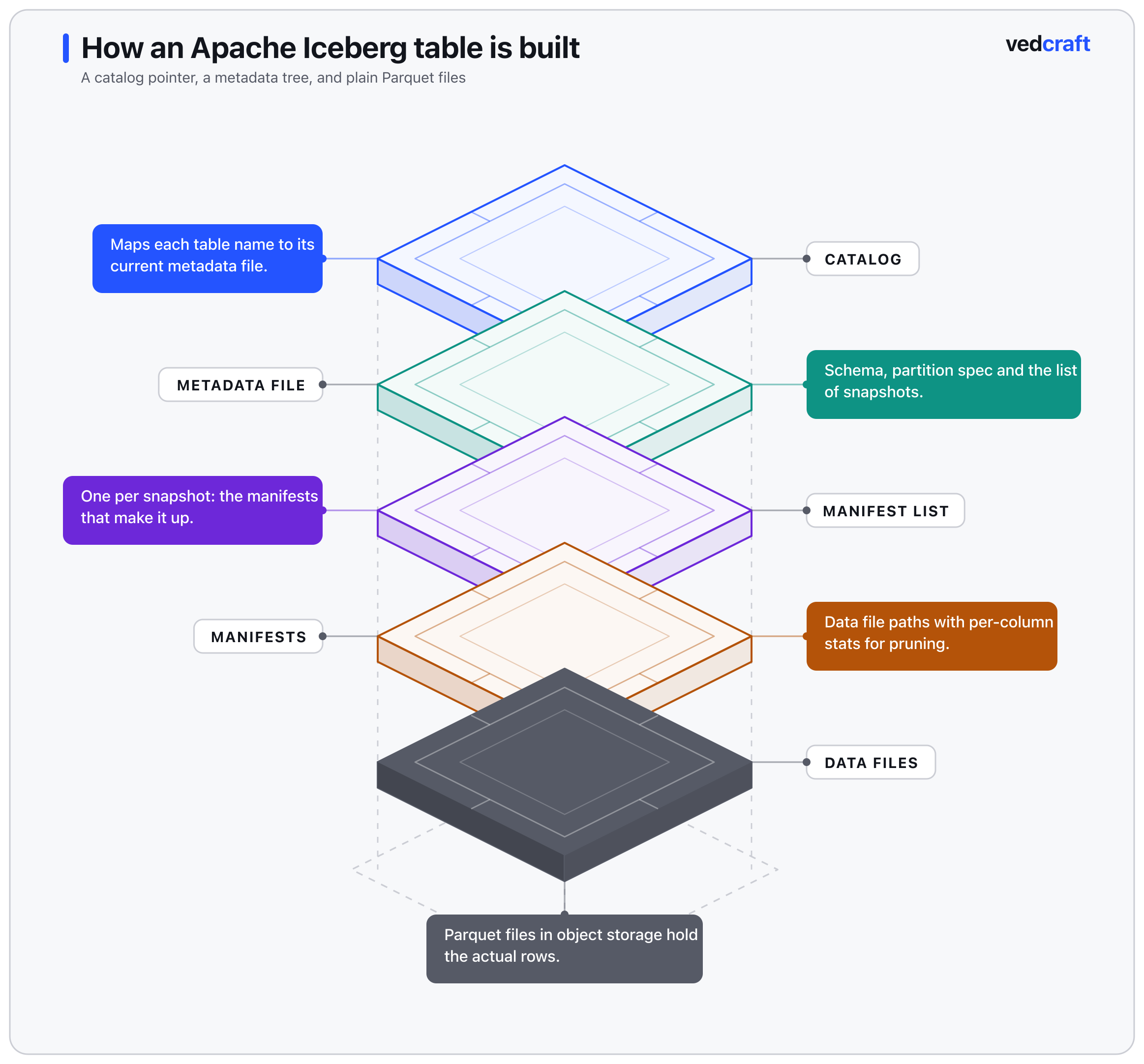
For the full metadata model, see the [Apache Iceberg table spec](https://iceberg.apache.org/spec/).
### Q3) Do we have an open-source catalog solution?
While the catalog solution has been dependent on enterprise ecosystem, Apache Polaris is an open-source alternative as an emerging solution.
Databricks' Unity Catalog, AWS Glue Data Catalog, and Google BigLake Metastore are the alternatives. [Apache Polaris](https://polaris.apache.org/) is an open-source implementation of the Iceberg REST Catalog specification.
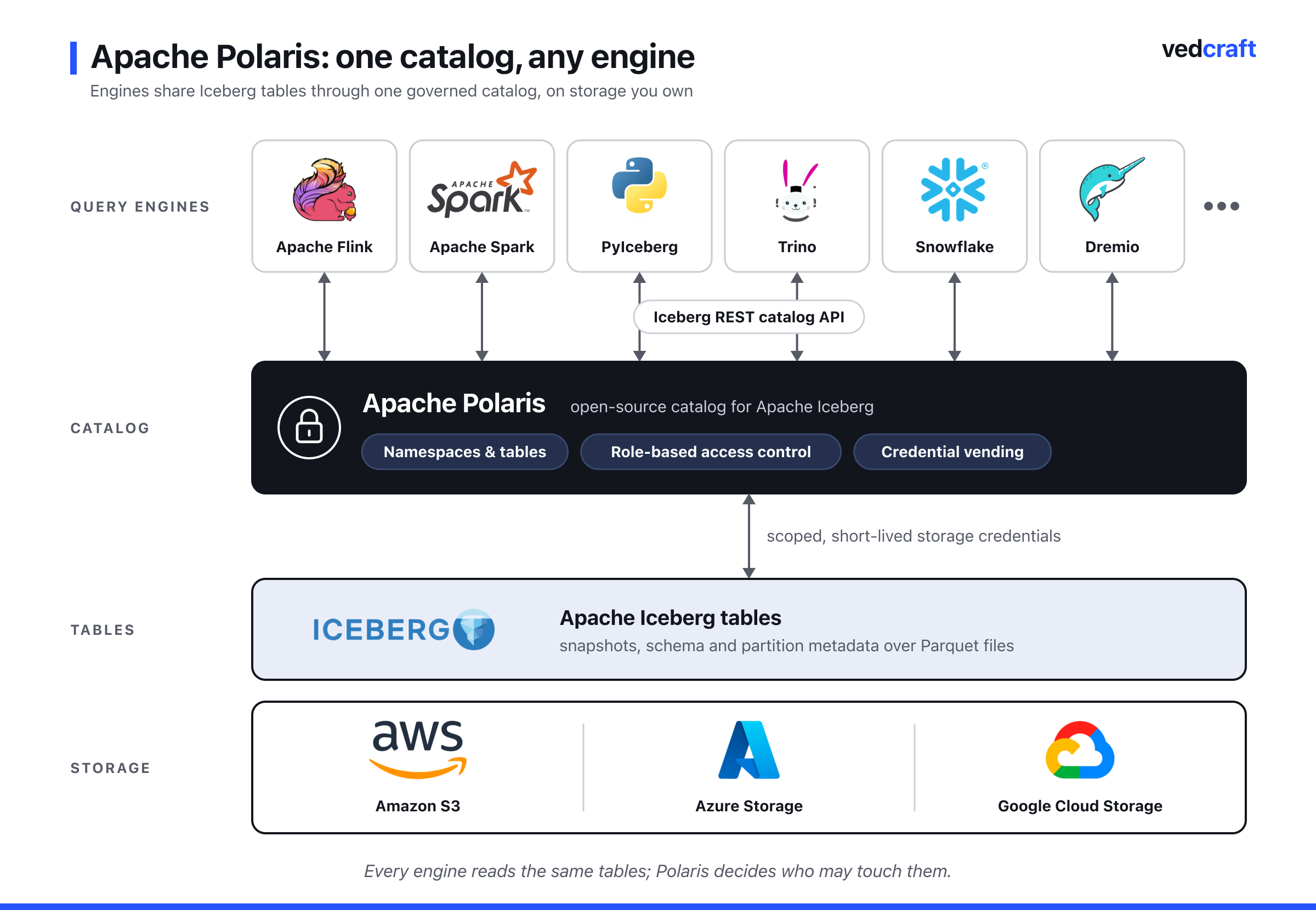
(Image adapted from: [Apache Polaris](https://polaris.apache.org/))
### Q4) Is there a vendor-neutral open-source alternative for semantic layer as well?
Semantic layer has emerged as an enabler for agentic AI applications and popular vendor solutions include Cube, dbt Semantic Layer, and AtScale, alongside data warehouse-native options like Snowflake Semantic Views and Databricks Metric Views.
[Apache Ossie](https://ossie.apache.org/) (earlier Open Semantic Interchange) is an open specification for semantic layers and ontologies. It entered the Apache Incubator on June 22, 2026. Ossie defines a vendor-neutral YAML format for expressing metrics, dimensions, relationships, and broader business concepts.
So, yes - the alternative in open-source is getting established while currently it is an incubating project.
### Q5) Do we have an in-memory layer available in open-source? Why do we need that?
Yes - the open-source data stack leverages [Apache Arrow](https://arrow.apache.org/) as a standard columnar layout for data in memory.
It solves the challenge of data movement (serialization and deserialization into wire format for data transfer) by making the in-memory format identical to the wire format with zero parsing or copying overhead.
### Q6) For agentic AI, how does the open data stack fit into the architecture?
The open data stack augments the agentic AI stack and provides a vendor-neutral foundation for it. People reach the data through APIs, SQL and BI tools, while agents reach the same data through MCP and A2A. Both land on one shared semantic layer, which sits on an open query engine, an open catalog, Iceberg tables and Parquet files in storage you own.